
What’s in this article
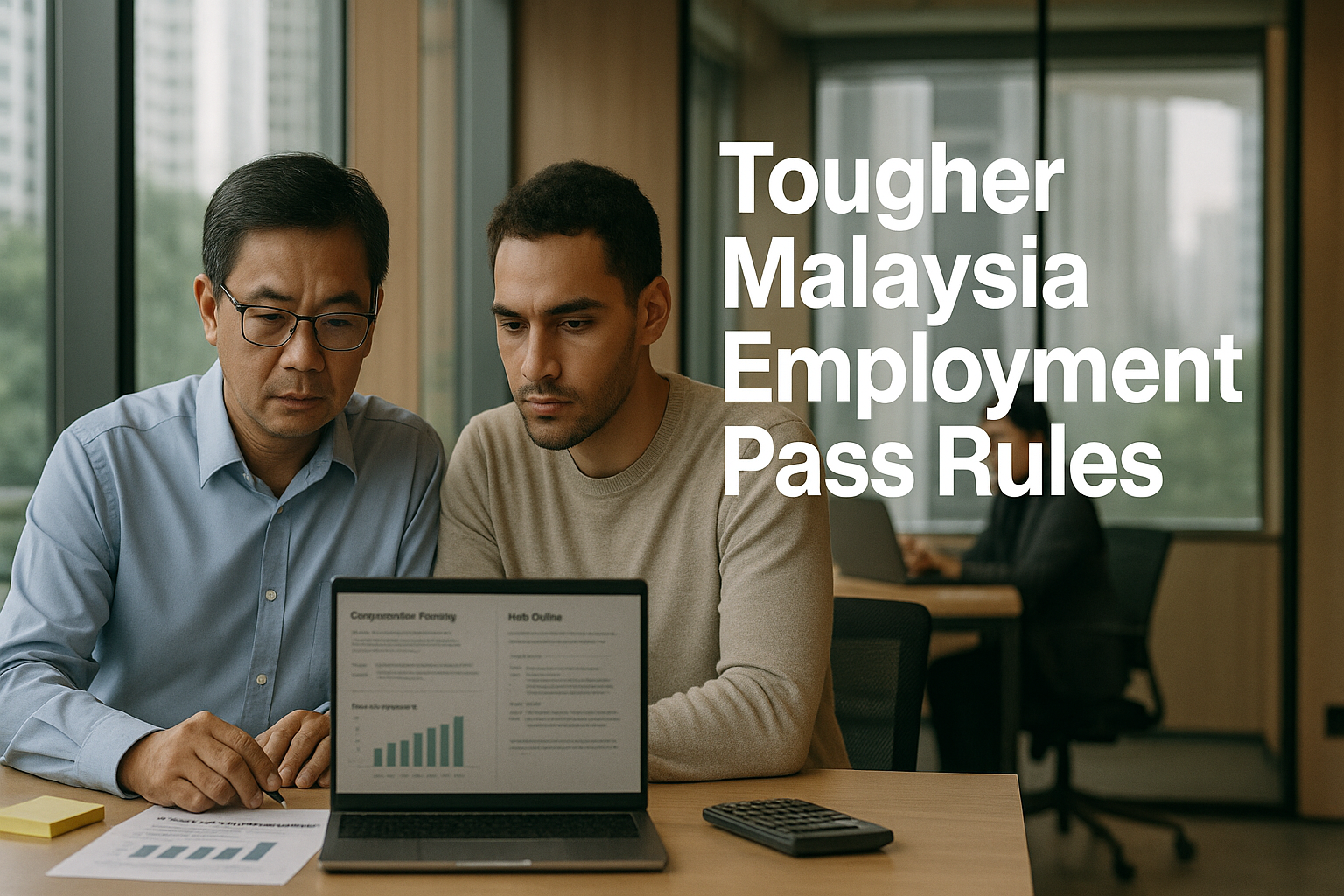
Malaysia Employment Pass changes from 1 June 2026—especially higher salary thresholds—turn “just hire an expat” into a strategic constraint rather than an admin step. For SMEs and scaling startups, the impact is rarely limited to the candidate’s pay: it cascades into total compensation, internal equity, time-to-hire, approval uncertainty, renewal risk, and the need for back-up coverage if a critical role is delayed. The practical question for management is no longer “Can we get an EP?” but “Which roles truly justify EP dependence, and how do we build capability so the business is not hostage to approvals?” This guide lays out a 2026–2027 roadmap: role design options, build-vs-buy decisions, budgeting the real expat cost, lead-time planning, and succession/retention moves that reduce reliance on EP outcomes.
What changes in your hiring economics when EP thresholds rise—beyond the headline salary number?
Higher EP salary thresholds are easy to read as “we need to pay more.” In practice, they shift the economics of a hire across four dimensions that matter to founders and HR leaders.
1) Total reward inflation (not just base pay)
Once a minimum salary level becomes the entry ticket, employers often feel pressure to adjust:
- Allowances and benefits (housing, schooling support, relocation, medical coverage, flights).
- Tax equalisation discussions for senior hires (even if you ultimately decline it, it becomes a negotiation point).
- Contract expectations (longer notice, severance expectations, more protective clauses).
Even if allowances are not legally required, they affect acceptance rates at senior levels—so the “true cost to land the hire” rises.
2) Internal equity and compression risk
A higher-paid expat can create compression with:
- Your Malaysian managers who “own” day-to-day delivery.
- Regional hires in Singapore/Thailand/Vietnam who are benchmarked differently.
- High-performing locals you are trying to retain.
The business impact is downstream: morale issues, attrition spikes, and unplanned pay adjustments to restore fairness.
3) Time-to-hire lengthens—and becomes less predictable
When approvals become tighter, your hiring timeline becomes less like a normal recruitment process and more like a project with dependencies:
- Offer acceptance is not the finish line.
- Start dates become conditional.
- Your delivery plan needs interim coverage.
4) Approval and renewal become an operational risk
EP outcomes are not purely controllable. That forces management to treat EP-dependent roles like any other single-point-of-failure risk:
- Have a fallback.
- Reduce dependence through documentation and knowledge transfer.
- Plan renewals early.
Management takeaway: treat the EP threshold increase as a change in operating model economics and project risk—then redesign roles and plans accordingly.
Which roles should still be expat-dependent in 2026–2027, and which should be redesigned?
A practical way to decide is to separate “skills scarcity” from “leadership convenience.” Many SMEs default to expats for speed, brand, or founder comfort. Under tighter EP conditions, role design discipline matters.
A role triage framework (use before you open the requisition)
Classify each intended expat hire into one of three buckets:
Bucket A: Truly scarce, high-leverage, time-critical Characteristics:
- Direct revenue impact or core product risk.
- Cannot be realistically sourced locally within your timeline.
- High cost of delay (lost contracts, regulatory deadlines, security risk).
Examples (illustrative): niche engineering lead for a proprietary platform; regional compliance head for a regulated expansion; turnaround finance leader for a restructuring.
Bucket B: Senior oversight that can be regionalised Characteristics:
- Decision-making can be remote/hybrid.
- On-the-ground presence is helpful but not essential daily.
- Execution can be done by a strong local manager.
Redesign option: Split the role into (i) Malaysia delivery lead (local) and (ii) regional functional head (based offshore, visiting periodically).
Bucket C: Execution roles that were historically filled by expats Characteristics:
- Strong local supply exists with better planning.
- Knowledge can be trained.
- The expat adds speed, not uniqueness.
Redesign option: local hire + structured training + short-term specialist support (contracting, advisory, secondment).
Role redesign patterns that reduce EP dependence
- “Regional leader + local owner”: expat/overseas leader sets standards; Malaysian lead runs daily operations.
- “Build centre in MY, leadership elsewhere”: keep delivery in Malaysia; place the leadership role where hiring friction is lower.
- “Two-step hire”: hire a local deputy first, then hire an expat only if the gap remains after 90–120 days.
- “Contract-to-perm for specialist phases”: bring expertise for a defined implementation window instead of a permanent EP-dependent headcount.
Management takeaway: EP should be reserved for roles where the business case survives (i) higher total reward, (ii) longer lead times, and (iii) uncertainty—otherwise redesign.
How do you budget the real total cost of an expat hire under higher thresholds?
If you only budget base salary, you will under-estimate the cost and over-promise on project timelines. Build a “Total Cost to Employ (TCE)” view that Finance and HR both sign off.
Build a TCE template (what to include)
Direct cash compensation
- Base salary (at/above applicable threshold)
- Fixed allowances (housing, transport, cost-of-living)
- Variable pay assumptions (bonus, commissions)
People costs that scale with salary
- Employer statutory contributions where applicable (depending on employee status and prevailing rules)
- Insurance/medical premiums (often priced by coverage tier)
Mobility and settlement costs (often overlooked)
- Relocation support, temporary accommodation
- Flights, shipping
- Dependant support (if offered)
- One-off settling-in allowances
Recruitment and onboarding costs
- Agency fees / sourcing costs
- Background checks
- Equipment and tools
- Training time for team and manager
Compliance and process costs
- Immigration processing fees and document preparation (internal time + external support)
- Opportunity cost of delays (see below)
Add a “cost of delay” line item
When EP timelines lengthen, cost is not only cash—it is project impact.
- Lost revenue from delayed go-live
- Overtime/contractor spend to keep delivery on track
- Founder/leadership time diverted to firefighting
A practical approach is to model two scenarios:
- Start on planned date
- Start delayed by X weeks
Even a simple model forces a clearer decision: “Is this role worth EP dependence?”
Internal equity budgeting: the hidden multiplier
Before finalising an expat offer, run an internal equity check:
- Where will this salary sit versus your Malaysian managers?
- Who becomes a retention risk if you create a visible gap?
- What adjustments might you need in the next review cycle?
Management takeaway: Higher thresholds push you toward more disciplined TCE budgeting. The right question is not “Can we afford the salary?” but “Can we afford the system impact—equity, delay, and retention?”
How should you redesign your workforce plan timelines for longer lead times and approval uncertainty?
A 2026–2027 plan needs to treat expat hiring like a critical-path activity.
Move from “hire when needed” to a staged pipeline
For EP-dependent roles, plan in stages with explicit owners:
Stage 1: Role approval (Week 0–2)
- Confirm role necessity (Bucket A/B/C)
- Confirm budget using TCE
- Assign a local successor candidate (even if early)
Stage 2: Sourcing + conditional offer (Week 2–8+)
- Start earlier than your historical norm
- Write offers with realistic start-date language
- Prepare documentation early to avoid rework
Stage 3: Interim coverage (runs in parallel)
- Identify an acting owner for the function
- Define “must-not-fail” outputs for the next 90 days
- Approve contractor budget if needed
Stage 4: Onboarding + capability transfer (first 90–180 days)
- Build a transfer plan (see succession section)
- Measure outcomes, not activity
Renewal planning: treat it like a key account renewal
Even when an expat is performing well, renewal risk can disrupt operations. Practical controls:
- Maintain a renewal calendar with internal reminders well ahead of expiry.
- Keep role scope and reporting lines documented and consistent.
- Track travel plans and project milestones so renewals do not collide with critical delivery windows.
Contingency planning for “no” or “not yet” outcomes
Avoid a binary plan (“approved” vs “we’re stuck”). Pre-define options:
- Option A: Local interim lead + remote expat advisor
- Option B: Regional hire outside Malaysia + periodic on-site visits
- Option C: Contractor specialist for 3–6 months while local team ramps
Management takeaway: The winning move is earlier planning and parallel coverage, not faster paperwork. You cannot fully control approvals; you can control preparedness and operational resilience.
What does “build vs buy” look like when expat hiring becomes a constrained resource?
When EP hiring is harder, “buying” capability through a foreign hire becomes a premium option. That shifts attention to how quickly you can build capability locally and what support you need to de-risk the build.
A practical build-vs-buy scorecard
Use these decision factors and score each 1–5:
- Time-to-competence: how long until a local hire performs independently?
- Failure cost: what happens if the role underperforms for 6 months?
- Repeatability: is this a one-off skill or a capability you will need repeatedly?
- Teachability: can the skill be trained with structured mentorship?
- Market availability in Malaysia: can you recruit locally with the right compensation and branding?
Interpretation:
- High failure cost + low teachability may justify an expat (or high-end contractor) even at higher thresholds.
- High repeatability + teachability usually points to building local capability.
Common “build” models for Malaysian SMEs
- Hire a strong local manager earlier than you think and let them scale with the company.
- Use short-term external specialists (implementation, architecture, process redesign) while locals run operations.
- Create a Malaysia centre-of-excellence for functions like shared services, analytics, customer support, finance operations—while keeping niche leadership regional.
Common “buy” models that reduce EP dependence
If you still need international capability:
- Remote-first regional hire with clear governance and travel cadence.
- Project-based secondments (time-bound expertise rather than permanent headcount).
Management takeaway: EP constraints push you toward capability building as a strategic asset. Buying expertise still happens—but more often in modular, time-bound ways.

How do you build local succession into every EP-dependent role without slowing the business down?
Succession planning often fails in SMEs because it is treated as a “nice-to-have HR programme.” Under tighter EP conditions, it is a continuity control.
Make succession a deliverable of the expat hire
Write it into the role outcomes, not just HR policy. Within the first 90–180 days, the expat role should deliver:
- A documented operating playbook (processes, decision rules, vendor contacts)
- Training sessions for the local team
- A named local “shadow” who co-owns key deliverables
- Handover criteria (what the shadow must demonstrate)
Use a simple 3-layer capability transfer plan
Layer 1: Documentation (Week 1–6)
- SOPs, checklists, templates
- Access and credentials governance
Layer 2: Shadowing (Month 2–4)
- Joint ownership of meetings and approvals
- “Explain-the-why” sessions, not just tasks
Layer 3: Delegation with control (Month 4–9)
- Local lead runs; expat reviews
- Gradually reduce review frequency
Measure succession with operational metrics
Avoid vague statements like “train the team.” Use measurable indicators:
- % of key workflows documented and used
- Number of decisions delegated without rework
- Cycle time and quality metrics before/after delegation
- Coverage readiness: “If this person leaves for 30 days, do we still deliver?”
Management takeaway: Succession is not an HR template; it is an operational deliverable that protects revenue and continuity when EP timelines or renewals do not go to plan.
How do you protect retention and engagement of your Malaysian talent when expat packages rise?
A higher threshold can unintentionally signal that “foreign talent is valued more.” If you do nothing, your best Malaysians may test the market—especially those already operating at regional standards.
Address internal equity proactively
Before the expat starts (or before you announce the hire):
- Calibrate job levels and titles so comparisons are fair.
- Clarify what the expat role is accountable for that locals are not.
- Align performance bonus logic across comparable levels.
Build a local growth proposition tied to capability transfer
Retention improves when people see:
- A real path to own the function
- Exposure to regional stakeholders
- Skills that raise their market value
Practical moves:
- Appoint a local deputy with a defined 12–18 month progression plan.
- Put Malaysians into cross-border project roles (even if travel is limited).
- Budget for training that is directly linked to the expat’s playbook (tools, frameworks, certifications where relevant).
Protect the “critical middle”
Many SMEs focus on retaining top leaders but lose strong mid-level managers who carry operations. Controls:
- Regular stay interviews for critical roles
- Market check of key salary bands (not only senior roles)
- Workload controls during transition periods (avoid burning out the local team while waiting for EP outcomes)
Management takeaway: Higher expat costs increase the ROI of retaining and growing Malaysians. The cheapest retention lever is often clarity: clear levels, clear paths, and a real transfer of ownership.
What operating controls should management put in place to avoid EP-dependent single points of failure?
If one expat is a single point of failure, the business is fragile. Controls do not have to be heavy—just deliberate.
Control 1: Role risk rating
Label EP-dependent roles as:
- Critical (Tier 1): revenue, security, regulatory, or core product risk
- Important (Tier 2): major delivery impact but manageable with interim coverage
- Support (Tier 3): minimal disruption if delayed
Then set minimum controls by tier.
Control 2: Access and knowledge governance
Common failure mode: the expat “owns” systems, vendors, and decisions. Implement:
- Shared credential vaults / access logs
- Vendor contact redundancy (at least two internal points of contact)
- Documented approval limits and delegation rules
Control 3: Scenario planning for departure or non-renewal
For Tier 1 roles, require:
- Named interim owner
- Contractor bench option
- “Day 1 continuity pack” (who does what in the first 72 hours)
Control 4: Cross-functional sign-off on EP-dependent hires
Don’t let EP hiring sit only with HR. At minimum, require sign-off from:
- Hiring manager (delivery)
- Finance (TCE and delay model)
- HR (equity and retention impact)
- Operations/leadership (contingency plan)
Management takeaway: The goal is resilience, not bureaucracy. A few light controls prevent costly disruption when timelines change.
How should SMEs communicate and execute a 2026–2027 expat hiring plan without creating churn?
The final challenge is organisational: you need alignment without panic. Teams do better when they understand the operating logic.
Step 1: Publish a simple “talent principles” memo internally
Keep it short and operational:
- When we will consider expat hiring (Bucket A only, or defined criteria)
- Our default preference to build local capability
- Our expectation of capability transfer and documentation
- How compensation will be managed fairly
Step 2: Convert principles into a 12–18 month roadmap
A workable roadmap includes:
- 3–5 roles you will prioritise for local development
- 1–3 roles you may still hire internationally (with a plan B)
- Training and tooling budget tied to specific capability gaps
- Recruitment timeline assumptions that reflect longer lead times
Step 3: Run quarterly reviews like you would for sales pipeline
Track:
- Open roles and stage (sourcing / offer / immigration / onboarding)
- Cost-to-hire vs budget (TCE)
- Delivery risks caused by delayed starts
- Succession progress for EP-dependent roles
Step 4: Use external support selectively
Where firms like Paul Hype Page & Co. typically add value is not just filing support, but helping management run the plan end-to-end:
- Translating EP constraints into realistic hiring timelines
- Building TCE budgets and internal equity checks
- Setting renewal calendars and documentation controls
- Coordinating HR, finance, payroll, and immigration workflows so offers, onboarding, and compliance do not drift
Management takeaway: Execution wins come from clarity, cadence, and shared ownership—not from treating EP as a last-mile admin task.
Conclusion
From 1 June 2026, Malaysia’s higher EP salary thresholds make expatriate hiring a slower, more expensive, and less predictable lever—especially for SMEs. The practical response for 2026–2027 is a talent plan that assumes constraints: redesign roles so only truly scarce, high-leverage positions depend on EP; budget expat hires using total cost to employ plus delay scenarios; start earlier and run parallel interim coverage; and embed local succession, documentation, and delegation into every EP-dependent role. If you treat EP outcomes as an operating risk—managed with timelines, ownership, and controls—you protect delivery while building a stronger Malaysian leadership bench that reduces long-term dependence on approvals.
FAQs
They often push up total reward expectations (allowances and benefits), create internal equity pressure on local pay bands, and add process and delay costs that Finance and HR should model in a total cost to employ view.
Use role-splitting (regional leader + local owner), remote or hybrid regional oversight, two-step hiring (local deputy first), and time-bound specialist contracting while building local capability.
Run proactive internal equity checks, clarify job levels and accountability, create visible growth paths (like a named deputy role), and tie training and ownership transfer to the expat hire’s deliverables.
Roles that are truly scarce, high-leverage, and time-critical—where the cost of delay is higher than the added compensation and approval uncertainty—tend to justify EP dependence; other roles are usually better redesigned or localised.
Start earlier, treat EP-dependent hires as critical-path projects, run interim coverage in parallel, and plan onboarding around documented capability transfer so operations are not blocked by start-date movement.
Related Business Articles



Share This Story, Choose Your Platform!