
What’s in this article
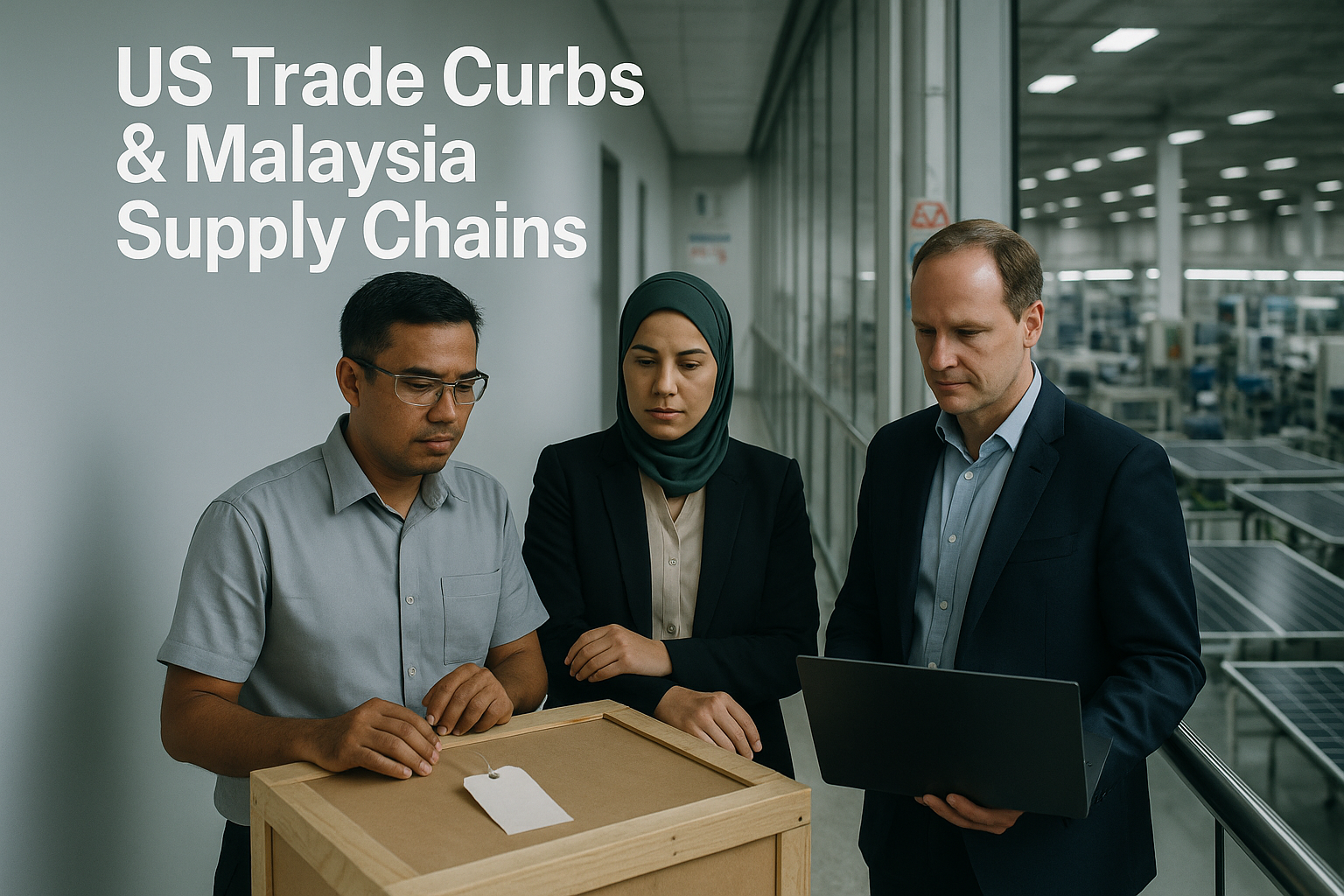
For many Malaysia exporters, “Malaysia export risk” is no longer a customs afterthought—it is a procurement score. US/EU buyers in solar, electronics, and semiconductor-adjacent supply chains now evaluate traceability, forced-labour/China-link exposure, and documentation readiness alongside price and yield. That changes what wins business: not only a capable factory, but a factory that can prove what it ships, where inputs came from, and how changes are controlled. The practical problem is implementation: most manufacturers have fragments of data across ERP, spreadsheets, and supplier emails, but not an audit-ready workflow that stands up to buyer scrutiny. This guide lays out a step-by-step roadmap to build BOM-to-supplier traceability, origin evidence packs, China-plus-one supply options, and customer-facing “low-risk” communication—without derailing operations.
What does “US trade curbs impact” mean in day-to-day procurement conversations?
Procurement teams rarely ask, “Are you compliant?” They ask operational questions that indirectly test risk:
- Can you show a full bill of materials (BOM) with supplier names, manufacturing sites, and country of origin for key inputs?
- If we single out one component (cells, wafers, substrates, lead frames, magnets, chemicals), can you produce supporting documents within 48–72 hours?
- What parts are China-origin or China-processed, and what’s your plan if we need a non-China alternative for the next build?
- Who signs the declarations, and what is your internal control that prevents “sales-friendly” statements from being issued without evidence?
The buyer-driven reality to plan for (2026–2027)
Procurement is increasingly structured around three internal stakeholders:
- Sourcing (cost, capacity, continuity)
- Trade/compliance (origin, forced-labour risk, sanctions exposure)
- Quality/engineering (change control, approved vendor list, product risk)
If your organisation can only answer with general assurances (“we source locally” / “we comply”), you will be compared unfavourably to competitors who can produce a clean documentation pack and offer a validated alternative BOM. The operational goal is not perfection—it is repeatable evidence production and controlled choices.
A useful internal definition of “low-risk”
For implementation purposes, define “low-risk supplier” as:
- Traceable: you can map finished goods → BOM → suppliers → (where possible) tier-2/3 sources for high-risk categories
- Documented: you can assemble an origin and due diligence pack quickly, consistently, and without reinventing it each time
- Change-controlled: you can switch sources without breaking quality/customer approvals, and you can prove what changed, when, and why
- Communicable: your sales/BD team can explain your status confidently using approved language and evidence
Which products and inputs should you prioritise first (so you don’t boil the ocean)?
Most Malaysia manufacturing groups make multiple SKUs for different customers and end-markets. Trying to fully trace everything at once is how programs stall.
Step 1: Segment your revenue by “scrutiny level”
Create a simple matrix using the last 12 months of shipments:
- End-market: US / EU / other
- Customer type: tier-1 OEM, distributor, contract manufacturing customer, internal brand
- Product category: solar modules/components, EMS assemblies, semiconductor-related parts
- Buyer posture: has the buyer already asked for origin/traceability documents? yes/no
Prioritise the lanes where (a) revenue is material and (b) documentation requests are already occurring.
Step 2: Identify “high-friction inputs” that drive risk questions
Across solar/EMS/semicon-linked manufacturing, scrutiny typically concentrates on:
- Solar: cells, wafers, ingots, glass, backsheets/encapsulants, junction boxes, frames
- Electronics/EMS: PCBs, ICs, passives, connectors, harnesses, power devices, batteries, magnets
- Semiconductor ecosystem: substrates, lead frames, chemicals, specialty gases, precision parts, tooling
You don’t need tier-3 visibility everywhere on day one. Start with inputs that are:
- high value
- historically sourced through China or China-based groups
- known to trigger customer questionnaires
- difficult to substitute (long qualification cycles)
Step 3: Decide your first “documentation pack” scope
Pick one product family and define a minimum pack that you can reliably reproduce:
- BOM with supplier/site identifiers
- purchase and shipping evidence set (PO, invoice, packing list, bill of lading/air waybill)
- certificates/attestations (supplier declarations, test reports where relevant)
- internal manufacturing narrative (what is done in Malaysia vs elsewhere)
- change log (last 12 months of material changes)
This scope forces clarity: what you can prove today, and what you need to build.
How do you build BOM-to-supplier traceability that procurement teams actually accept?
The implementation mistake is treating traceability as a one-off spreadsheet exercise. Buyers want a system: consistent identifiers, evidence retention, and governance.
Build the traceability stack in four layers
Layer 1: Master data (the foundation)
- Standardise part numbers, supplier names, supplier site addresses, and country fields
- Create a unique ID for each supplier site (not just supplier HQ)
- Define controlled lists for country of origin, manufacturing country, and shipping-from country
Layer 2: BOM mapping (what goes into what)
- For each finished good / assembly: map BOM line → approved supplier(s) → supplier site(s)
- Flag “house part” vs “customer-supplied part” (critical for EMS—see later section)
- Tag high-risk materials for deeper visibility
Layer 3: Transaction linkage (prove it happened)
- Link each lot/batch/serial range to:
- inbound receipts (GRN)
- supplier invoice and shipment documents
- production order / traveler
- outbound shipment documents
Layer 4: Evidence library (audit-ready retrieval)
- A structured repository where a non-expert can retrieve the pack within hours
- Version control: every document has an owner, date, and product association
Practical system choices (without a full ERP overhaul)
Many Malaysia plants run a mix of ERP + MES + spreadsheets. You can still execute with:
- a controlled template for supplier site data
- a central document repository with naming conventions (even before full automation)
- a lightweight workflow tool for approvals and change requests
- periodic master data cleansing (monthly is realistic)
The goal is not a perfect platform—it’s repeatability.
Control point to add early: “traceability completeness” KPI
Track, by product family:
- % BOM lines mapped to supplier site + origin fields
- % inbound lots with linked documents
- average time to assemble a customer pack
- number of exceptions requiring manual chasing
These metrics expose where the process breaks (usually master data and supplier site ambiguity).
How do you get tier-2/tier-3 visibility without turning it into an impossible supplier interrogation?
Buyers increasingly ask for upstream visibility, but many of your tier-1 suppliers will resist giving full tier-2 lists. You need a pragmatic approach that still reduces risk.
Start with “tier-2 for high-risk categories”
Define categories where upstream matters most (example):
- solar cells/wafers/ingots
- certain minerals/metals and magnets
- high-risk chemicals or materials with limited global sources
Require tier-2 information only for those categories, not for every screw and label.
Use a three-band supplier disclosure model
Ask tier-1 suppliers to disclose at one of three levels:
- Full: tier-2 supplier site(s) + country
- Partial: country of tier-2 processing + attestation
- Attestation-only: statement against defined risk criteria, with audit rights / escalation triggers
This gives suppliers an on-ramp and gives you a way to grade confidence.
Build escalation triggers (so you know when to push harder)
Escalate from band 3 → band 2/1 when:
- the input becomes US/EU-bound
- the buyer requests deeper traceability
- the supplier changes manufacturing site
- there is a material shortage causing broker sourcing
Practical note for Malaysia operations
Malaysia’s supplier ecosystem often includes distributors who source regionally. Distributors can be a weak link for origin clarity. For high-risk inputs, aim to contractually require either:
- manufacturer certificate/attestation attached to each shipment, or
- distributor-provided trace that identifies the manufacturer site
Even if you cannot fully verify tier-3, having a documented methodology (and exceptions log) is materially better than ad hoc responses.
How should you design an audit-ready “origin & traceability documentation pack” for customers?
A documentation pack is not a folder of PDFs. It is a consistent story supported by linked evidence.
What buyers typically want (and how to structure it)
Build a pack per product family (and per customer when needed) with these modules:
Module A: Product and manufacturing overview
- product description and HS code used internally (if applicable)
- manufacturing flow: what steps are performed in Malaysia
- list of facilities involved (own plant + subcontractors)
Module B: BOM and sourcing map
- BOM with supplier site details for key inputs
- classification of inputs: customer-supplied vs house-sourced
- high-risk inputs highlighted with deeper documentation
Module C: Origin logic (your working position, not a legal essay)
- a clear statement of how you determine origin for your shipments
- the evidence you rely on (supplier declarations, manufacturing steps, transaction docs)
- what you do when origin is ambiguous (hold, escalate, or ship with qualified statements)
Module D: Evidence set
- representative POs, invoices, packing lists, bills of lading/air waybills
- supplier certificates/attestations
- incoming inspection / lot trace (where relevant)
Module E: Controls and governance
- who is authorised to sign declarations
- review workflow and record retention rule
- change control summary (what triggers a re-issuance)
Build for speed: the 72-hour test
Run an internal drill:
- pick a random shipment to a US/EU customer
- time how long it takes to assemble the pack
- record every missing data point
Then fix the workflow, not the symptoms. Common blockers are missing supplier site addresses, inconsistent part numbers, and documents stored in personal inboxes.
Evidence retention: decide the “source of truth” now
Do not let each department keep its own version. Choose one repository and enforce:
- naming conventions (customer / product / lot / date)
- access control
- versioning
- retention period aligned to your customer contract expectations and internal policy
This is where an implementation partner such as Paul Hype Page & Co. can add value: mapping the workflow across procurement, production, finance, and sales so the pack is reproducible and defensible, not person-dependent.

How do you implement China-plus-one supply options in a Malaysia plant without breaking quality or margins?
“China-plus-one strategy Malaysia” cannot be a slogan. It is an engineering + procurement + finance program with governance.
Treat diversification as a design problem: three options
Option 1: Alternate suppliers for the same spec (single BOM)
- Pros: simpler configuration control
- Cons: alternates may still be China-linked; qualification can be slow
Option 2: Dual-BOM strategy (China-leaning BOM vs non-China BOM)
- Pros: clear routing for US/EU vs other markets; faster commercial response
- Cons: more complexity in inventory, planning, and customer approvals
Option 3: Modular substitution (design-to-switch)
- Pros: reduces requalification scope by isolating high-risk components
- Cons: may require product redesign, tooling changes, or firmware changes
For EMS and electronics, Option 2 is often the most commercially practical: it aligns with buyer segmentation.
Implementation sequence (what to do first)
- Select target assemblies where buyer scrutiny is highest
- Identify “risk-driving lines” in the BOM (components most likely to trigger questions)
- Source alternates with documented supplier site + origin information upfront
- Qualify alternates using a standard qualification plan (quality + reliability + process impact)
- Update planning rules in ERP/MRP so buyers don’t accidentally ship the wrong BOM to the wrong market
- Implement change control (ECO/PCN discipline) tied to documentation updates
Cost and margin management: avoid hidden erosion
China-plus-one can raise unit cost. Manage it explicitly:
- separate the cost impact by component category
- negotiate based on volume commitments by market
- use dual-BOM pricing: show customers the price delta for “non-China BOM” rather than burying it
A common execution failure is switching suppliers without locking down documentation requirements. If an alternate supplier cannot provide stable evidence (site, origin, consistent certificates), you may solve cost risk but create documentation risk.
Governance: create a cross-functional “BOM risk council”
Monthly, 30–45 minutes, with:
- procurement (supplier changes)
- engineering (qualification)
- quality (approval status)
- finance (margin impact)
- sales (customer commitments)
Outputs should be concrete: approved alternates, blocked suppliers, and a prioritized list of documentation gaps.
What changes in contract manufacturing (EMS) when customers supply parts vs when you source parts?
EMS adds a boundary problem: documentation responsibility depends on who buys and controls the parts.
Separate the work into two lanes
Lane A: Customer-supplied parts (consigned / free-issue)
- You typically control receiving, storage, trace within your factory, and assembly records
- The customer often owns upstream origin documentation—but buyers may still ask you for trace within your operations
Lane B: House-sourced parts (you procure)
- You own supplier selection, evidence collection, and the integrity of upstream declarations
- You are expected to provide origin/traceability support to your customer
Implement clear responsibility mapping (RACI)
For each product family, define who is Responsible/Accountable/Consulted/Informed for:
- supplier onboarding and site identification
- collecting and validating supplier declarations
- maintaining AVL (approved vendor list)
- issuing customer statements (origin, traceability, forced-labour questionnaires)
- responding to audits or questionnaires
If you do not formalise this, sales may commit to documentation that operations cannot support, or operations may assume the customer will provide evidence that the customer expects you to hold.
Contract and process alignment (without turning this into a legal exercise)
Operationally, ensure your statements to customers are consistent with:
- what you can evidence (especially for consigned parts)
- how you handle shortages (broker buys are high-risk)
- whether you can refuse to build with undocumented substitutes
Practical control: No substitute material for US/EU-bound builds without a documentation check and an authorised approval.
A real-world scenario
- A customer consigns ICs and asks you to sign a traceability questionnaire for the finished assembly.
- Your best position is to provide:
- trace within your plant (receipts, lot trace, build records)
- a clear boundary statement: upstream origin for consigned ICs is provided by customer
This is not about avoiding responsibility—it’s about ensuring your commitments match your control.
How do you prevent documentation from collapsing when suppliers change, shortages happen, or teams improvise?
Trade compliance and documentation fail most often during exceptions: last-minute substitutions, expedited shipments, and new suppliers.
Build three “non-negotiable” controls
Control 1: Supplier onboarding gate Before a supplier site is approved for high-risk inputs, require:
- supplier site details (not just HQ)
- country of manufacture/processing fields completed
- baseline declarations/attestations received
- agreement on what documents accompany each shipment
Control 2: Engineering change + documentation linkage Every ECO/PCN that changes a high-risk BOM line must trigger:
- update to the sourcing map
- update to the documentation pack
- customer notification where required by contract
Control 3: Shipment release check for sensitive lanes For US/EU-bound shipments (or identified customers), implement a light “release checklist”:
- correct BOM variant used
- lot trace complete for high-risk parts
- evidence set available (or exception formally approved)
Keep an “exceptions log” and use it commercially
Instead of hiding gaps, track them:
- what was missing
- why it happened
- whether shipment proceeded
- corrective action and due date
This log becomes a management tool. It also supports a credible buyer conversation: “Here’s our process, here’s what we track, and here’s how we reduce exceptions quarter by quarter.”
Train sales and customer service (so they don’t overpromise)
Create approved language for:
- what you can certify
- what you can attest with supplier support
- what requires qualification time
Many plants invest in data work but lose control at the customer interface. A 60-minute quarterly training and a controlled template library (questionnaires, declarations, cover letters) prevents inconsistent statements.
How should you communicate “low-risk” status to US/EU buyers without making risky promises?
Communication is part of implementation. Buyers want clarity and evidence, not broad claims.
Build a customer-facing “assurance bundle”
For priority customers, prepare a concise bundle:
- 1–2 page traceability overview (what you track, how fast you can respond)
- product-family documentation pack (from earlier section)
- summary of your China-plus-one options (what alternates are qualified and lead times)
- boundary statements for EMS (customer-supplied vs house-sourced)
Use “graded statements” instead of absolute claims
Examples of safer, practical positioning:
- “For this product family, we maintain lot-level traceability for specified inputs and can provide supporting transaction documents on request.”
- “For high-risk components, we maintain supplier site identifiers and require supplier declarations as part of onboarding.”
- “We can offer an alternative BOM for US/EU-bound builds; component substitution is managed via change control and customer approval.”
Avoid absolute, unverifiable statements like “no China content” unless you can prove it and maintain it through change control.
Align your internal narrative
Ensure sales, procurement, and operations tell the same story:
- what is made in Malaysia
- what is imported
- what is controlled vs what is customer-owned (EMS)
Inconsistent narratives raise buyer suspicion faster than a documented limitation.
How do you diversify end-markets without breaking US/EU customer commitments?
Market diversification is often discussed as “sell more elsewhere.” Operationally, you must sequence it so you don’t create supply conflicts or violate customer expectations.
Step 1: Quantify exposure with an operational lens
Go beyond revenue by market. Add:
- capacity allocation by customer/market
- unique tooling or line constraints
- component constraints (single-source parts)
- working capital impact (inventory and receivables by market)
This tells you how difficult it is to pivot.
Step 2: Decide what diversification means for your plant
Common strategies in Malaysia manufacturing:
- End-market split by BOM variant (keep US/EU on non-China BOM where needed; sell other markets with standard BOM)
- Product mix shift (prioritise less scrutinised assemblies for non-US/EU markets)
- Customer portfolio (add customers in markets with different risk questions, while maintaining your US/EU service level)
Step 3: Sequence changes so you don’t create self-inflicted disruption
A workable sequence:
- Stabilise documentation and traceability for existing US/EU lanes (protect current business)
- Build supply options (dual-BOM / alternates) for those lanes (reduce risk of future disruptions)
- Only then increase non-US/EU volume if it does not consume constrained inputs or capacity
Step 4: Communicate proactively to strategic buyers
If you diversify, some buyers worry you will deprioritise them. Counter that with:
- confirmed capacity commitments
- lead time policy
- documented change control
- clear escalation path
Diversification works best when it is positioned as resilience: “We are strengthening continuity,” not “we’re moving away from you.”
Conclusion
For Malaysia-based manufacturers facing the US trade curbs impact, the competitive edge is no longer just throughput and quality—it is the ability to prove your supply chain story on demand and to offer controlled sourcing options when buyers tighten rules. The implementation path is straightforward but disciplined: prioritise products and inputs, build BOM-to-supplier traceability, add tier-2 visibility where it matters, standardise an origin/traceability documentation pack, and govern China-plus-one choices through change control. EMS players should explicitly separate customer-supplied versus house-sourced responsibility so documentation commitments match real control. If you want support turning these steps into a working cross-functional workflow—data, document retention, internal controls, and customer-facing packs—Paul Hype Page & Co. can act as an implementation and evidence-readiness partner alongside your procurement, quality, and finance teams.
FAQs
Start by prioritising US/EU revenue lanes where documentation requests already occur, then focus on high-friction inputs (high value, China-linked, hard to substitute) and build a minimum repeatable documentation pack for one product family first.
They usually ask for a BOM with supplier site and country fields, supporting documents for specific components within 48–72 hours, clarity on China-origin or China-processed inputs, and who is authorised to sign declarations with what internal controls.
A consistent pack typically includes a product and manufacturing overview, BOM and sourcing map with supplier site identifiers, a clear origin logic narrative, linked transaction evidence (POs, invoices, shipping docs), and governance items like signing authority, retention, and change-control triggers.
For customer-supplied (consigned) parts, you typically provide traceability within your plant (receiving, storage, lot/build records) while the customer owns upstream origin evidence; for house-sourced parts, you own supplier onboarding, declarations, and the integrity of the sourcing evidence you provide.
Limit tier-2 requests to high-risk categories and use a three-band disclosure model (full, partial, attestation-only), with escalation triggers when inputs are US/EU-bound, buyers ask deeper questions, supplier sites change, or broker sourcing occurs.
Related Business Articles


Share This Story, Choose Your Platform!