
What’s in this article
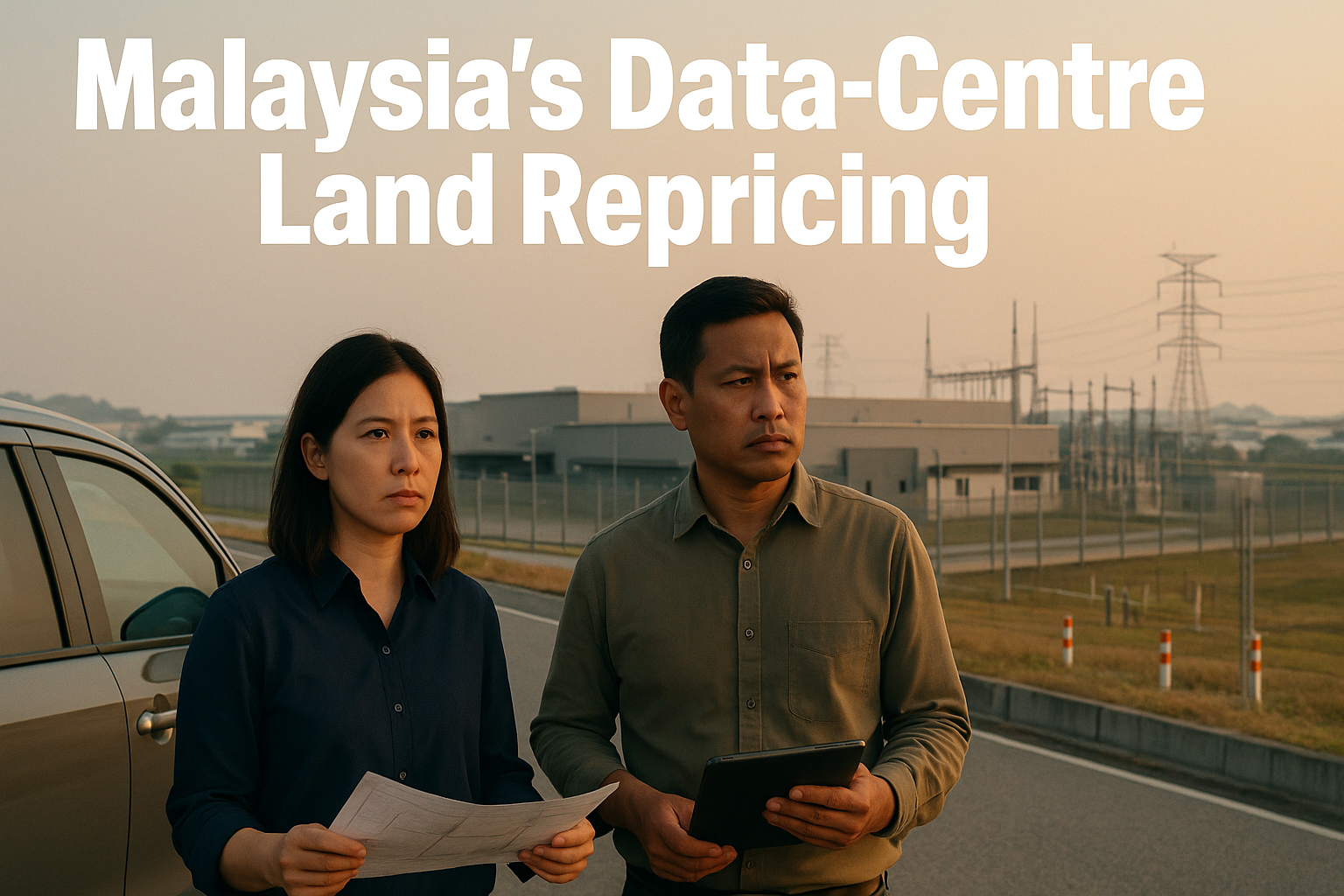
Signals like the Sepang land disposal to a data-centre player are less about property headlines and more about a new operating reality: in Malaysia data-centre corridors, “power + fibre + zoning” is becoming the value stack that determines which sites can scale—and which get priced out or capped. For SME owners, landlords, manufacturers, and regional founders, the business problem is not whether data centres are “good”. It is whether your next site, renewal, or expansion ends up locked into slow grid connections, power allocation caps, utility pass-through shocks, or rent creep—while your customers and vendors migrate to corridor locations. This guide gives a practical decision framework to map exposure, choose sites and leases with power-and-fibre constraints in mind, and capture corridor upside without losing flexibility before 2027 repricing is fully reflected in terms and valuations.
What has changed—and why is “power + fibre + zoning” now the decision stack (not acreage or postcode)?
For most industrial and commercial property decisions, founders used to start with: location, land size, access roads, and rent per square foot. That still matters—but in spillover zones around data centres, you often feel constraints in a different order.
The new stack founders experience first
- Power availability (and the ability to increase it later): You can sign a lease today and still wait months for upgrades, substation work, or approvals. Many businesses only discover limits after fit-out design, machinery ordering, or tenant improvement discussions.
- Fibre availability and route diversity: Not every “served” building is equal. A single-provider, single-route building can be fine for basic connectivity but fragile for operations that depend on uptime, cloud connectivity, CCTV, ERP, or latency-sensitive customer requirements.
- Zoning and permitting path: The question is less “is it industrial?” and more “can we actually run the intended load/use within the approvals path and timeline?”
Why this matters commercially
When power and fibre become scarce (or slow to upgrade), they start behaving like scarce inputs:
- Landlords price in “power readiness” as a premium.
- Tenants accept longer terms to secure capacity.
- Renewals become less about base rent and more about who bears utility upgrades, demand charges, and capex.
Practical implication for founders
Treat power and fibre like core production inputs, not overheads. If your expansion plan assumes you can “add another line” later, you’re exposed. Your decision stack should start with:
- Can we secure enough power now?
- Can we scale power within 12–24 months?
- Is fibre resilient enough for our operations?
- Is zoning/permitting path predictable?
- Only then: price, location, and building layout.
How do you map exposure to Malaysia data-centre corridors without turning it into a research project?
You don’t need a perfect corridor map. You need a decision-ready view of: where capacity is being pulled, where constraints will tighten, and where spillover demand will land.
A founder-friendly corridor mapping method (4 layers)
Layer 1: Anchor nodes (where demand concentrates)
- Look for clusters of large power users, hyperscale/colocation builds, and substations/upgrades being discussed in the market.
- Treat announcements and land transactions as signals—but focus on what they imply: grid queueing, contractor demand, security services, transport flows.
Layer 2: Enabling infrastructure (the “can it actually run” layer)
- Power: proximity to substations is not the same as available capacity.
- Fibre: presence of multiple carriers and diverse routes matters more than marketing brochures.
- Water/cooling constraints (where relevant): certain operations may face practical limits during dry periods or where supply expansion is slow.
Layer 3: Spillover zones (where SMEs feel it) These are typically:
- Industrial parks within a workable drive time to the anchor node
- Logistics nodes (highway interchanges, freight corridors)
- Worker housing catchments (areas that can house technicians, security, drivers, and vendor staff)
Layer 4: Friction zones (where projects stall or costs jump)
- Areas with longer connection lead times
- Buildings with landlord-controlled utilities and opaque pass-throughs
- Sites with limited backup generation allowances or neighbour sensitivity
Output you should aim for (one-page internal memo)
Create a simple table with 8–12 candidate zones:
- Expected power availability (today / expandable)
- Fibre resilience (single vs multi-provider)
- Permitting predictability (high/medium/low)
- Rent pressure risk (high/medium/low)
- Customer/vendor proximity benefit (high/medium/low)
- “Failure mode” (what breaks first: power, fibre, approvals, labour, traffic)
The goal is not to predict prices. It’s to avoid signing a site that fails operationally when you try to scale.
Should you move closer to a corridor—or design for resilience further out?
A common founder dilemma: “Do we chase proximity to corridor demand, or avoid the cost and congestion?” The right answer depends on how your business makes money and what fails you first.
A practical proximity vs resilience decision test
Score your business on these dimensions:
1) Revenue sensitivity to corridor demand (0–5)
- 5: You sell to data-centre operators, contractors, or corridor tenants (M&E, security, cleaning, catering, spares, logistics, recruitment).
- 0: Your customer base is unrelated and remote.
2) Operational sensitivity to power and connectivity (0–5)
- 5: Downtime is expensive; you run automation, cold-chain, controlled environments, or 24/7 production.
- 0: Mostly office-based, flexible hours, low load.
3) Expansion cadence (0–5)
- 5: You plan to add shifts, equipment, or headcount within 12–24 months.
- 0: Stable footprint for 3+ years.
4) Logistics sensitivity (0–5)
- 5: Time-critical deliveries, heavy freight, or high trip volumes.
- 0: Low shipment frequency.
Interpreting the result
- High corridor revenue sensitivity + high expansion cadence: Bias toward corridor proximity, but negotiate power and utility terms aggressively.
- High operational sensitivity + moderate corridor revenue sensitivity: Bias toward resilience (power upgrade path, redundancy) even if slightly further out.
- Low corridor sensitivity: Treat corridor exposure mainly as a cost risk—protect yourself via lease structure and capex decisions.
Example scenarios
- Precision manufacturer adding automation: If your next line needs stable power quality and scalability, a “cheaper” site with uncertain upgrade timelines can cost more than the rent difference.
- 3PL / logistics operator: Corridor proximity can reduce empty miles and improve turnaround, but you must model traffic patterns, driver availability, and yard space constraints.
- Landlord with small-bay units: Corridor spillover can raise occupancy and rents, but only if your building can offer credible power specs and clear utility pass-throughs.
What questions should you ask about power before you shortlist a site or sign an LOI?
Many founders treat power as a standard utility. In corridor-adjacent markets, power becomes a negotiated asset.
Power due diligence (non-technical, decision-grade)
Ask for answers you can verify contractually or operationally:
Capacity and allocation
- What is the current allocated supply to the unit/building (not the theoretical maximum)?
- Is there a cap per tenant? Is it contractual or policy-based?
- What happens if multiple tenants expand at the same time?
Upgrade path and lead time
- If we need more power in 12–24 months, what is the process and who pays?
- What are realistic lead times for connection or upgrade work (get a range, not a promise)?
Commercial exposure
- Are utilities direct-billed to us, or landlord pass-through?
- How are demand charges or peak usage charges treated (if applicable to your tariff structure)?
- Can the landlord introduce new “energy management fees” or admin charges?
Reliability and contingencies
- What is the site’s history of outages (even informal info from neighbours helps)?
- Is backup generation allowed? If allowed, are there limits on run hours, noise, or fuel storage that affect feasibility?
Founder takeaway
If power is a constraint, it will show up as:
- delayed commissioning,
- forced de-scoping of equipment,
- expensive redesign of electrical distribution,
- or a rushed relocation.
Treat power questions as part of commercial negotiation—on the same level as rent and term.
How should you evaluate fibre and connectivity without getting pulled into technical debates?
You don’t need to debate latency charts. You need operational resilience and commercial clarity.
Connectivity checks that matter for SMEs
Provider diversity
- Can you contract with more than one carrier?
- Are there multiple entry points/routes, or is everything dependent on one duct/path?
Serviceability evidence
- Ask for proof of existing carrier presence in the building/park.
- Confirm typical installation lead times (again: ranges, not promises).
Operational impact
- If you run cloud-based ERP, POS, warehouse systems, or CCTV: what is your downtime tolerance?
- Do you have a backup connection plan (second line, 5G, or failover) and is the site friendly to it?
Common trap
Founders accept “fibre-ready” as a marketing phrase. Later they discover:
- only one provider can serve the unit,
- installation requires landlord approvals that take weeks,
- or internal building infrastructure constrains bandwidth.
Simple decision rule
If your operations cannot tolerate half a day of disruption, treat connectivity like power: you need redundancy options and a documented install path.

How do zoning and permitting risk show up as business risk (not compliance paperwork)?
Zoning and permitting are often framed as “compliance”. For founders, the real issue is timeline certainty.
Where permitting risk hits P&L
- Delayed start: rent starts, but revenue doesn’t.
- Capex stranded: machinery arrives before you can run it.
- Customer penalties: missed delivery commitments or lost contracts.
Decision-grade questions to ask early
- Does the intended use (manufacturing process, storage type, hours of operation, fleet movement) fit comfortably within the area’s typical approvals path?
- Are there known sensitivities (traffic, noise, emissions, neighbour complaints) that trigger extra scrutiny?
- What is the realistic timeline for approvals and utility connections running in parallel?
Practical control
Build a “permit and connection” timeline backward from your go-live date:
- Site selection and LOI
- Fit-out design freeze
- Utility applications
- Equipment order lead times
- Hiring/training ramp
Even if you outsource permitting work, the founder/GM must own the integrated timeline. That is the difference between a smooth launch and a costly idle period.
What lease terms change when power becomes scarce and corridor rents start creeping?
In repricing markets, base rent is only one part of the commercial outcome. The bigger risks often sit in clauses most SMEs skim.
Lease clauses to review with corridor conditions in mind
1) Renewal timing and options
- If you renew in 2027–2028, expect corridor repricing to be more fully embedded.
- Negotiate renewal options early, or at least a structured method (benchmarking rules, caps, or notice periods) to reduce surprise.
2) Escalation clauses
- Understand whether escalation is fixed, CPI-linked, or “market review”.
- Avoid ambiguous market review language without a clear mechanism.
3) Utilities and pass-throughs
- Clarify: direct billing vs landlord pass-through.
- Specify what can be passed through (electricity only, or also maintenance, admin fees, upgrading works, metering fees).
4) Demand charges and peak usage risk
- If your bill has a peak component, your operating cost can jump even if consumption stays flat.
- Consider operational changes (shift timing, staggered starts) and whether your lease lets you control the relevant equipment.
5) Fit-out power specs (and who pays if wrong)
- Attach power specifications as a schedule.
- Define who pays for upgrades if the delivered capacity doesn’t match what was represented.
6) Term length vs flexibility
- Longer terms can secure space, but can trap you if power is capped or the site becomes operationally unsuitable.
- Consider break clauses, expansion options, or rights of first refusal on adjacent units.
A practical founder stance
Negotiate leases as an operating contract, not a property formality. Your biggest corridor risk is not “higher rent”—it’s being stuck with a site that can’t scale or can’t control utility cost volatility.
How can SMEs capture corridor upside without taking corridor-level rent risk?
Not every business needs to be inside the corridor to benefit from it. Many wins come from being “corridor-adjacent” with a clear offer.
Three corridor-upside plays that don’t require premium locations
1) Vendor positioning (sell into the corridor) If you supply:
- maintenance consumables, parts, tools
- facilities services (security, cleaning, landscaping)
- workforce services (training, staffing, compliance admin)
- food, transport, accommodation
Then your advantage is response time, reliability, and compliance readiness, not a trophy address. A well-located service base with dependable power and connectivity may outperform a high-rent unit that strains margins.
2) Logistics and staging Corridor builds create demand for:
- temporary staging space
- last-mile delivery coordination
- returns and spares handling
These functions benefit from access to highways and predictable yard operations more than being next door to a data-centre site.
3) Worker housing and amenities (for landlords and operators) Spillover demand can lift:
- mid-market rentals
- F&B and convenience retail
- transport services
But only where commuting patterns make sense. Focus on housing catchments that can reliably serve shift work.
How to protect margins while participating
- Keep fixed commitments (rent, headcount) aligned to contracted demand.
- Use shorter leases for customer-dependent expansions.
- Build “modular capability”: add vehicles, tools, or shifts in increments.
Corridor upside is real, but it rewards operators who stay flexible.
What operational constraints will founders feel first—and how do you plan around them?
Before “valuation repricing” shows up, founders feel execution constraints: waiting, queueing, and caps.
Constraint 1: Power allocation caps
Symptoms: you can’t add equipment; landlord refuses upgrades; utility timeline slips. Controls:
- Secure written confirmation of current and expandable capacity.
- Stage equipment commissioning to match confirmed supply.
- Consider dual-site strategy: production in a stable-power zone, sales/service in corridor zone.
Constraint 2: Connection lead times
Symptoms: you sign, pay rent, but can’t operate at full load. Controls:
- Make lease commencement or rent-free periods align to realistic connection milestones.
- Put long-lead utility items on the critical path alongside permits and fit-out.
Constraint 3: Backup generation limits
Symptoms: you planned gensets as a workaround but face restrictions (space, noise, approvals). Controls:
- Check landlord rules and local sensitivities early.
- Design a continuity plan that doesn’t assume unlimited generator runtime.
Constraint 4: Cooling/water limitations (where relevant)
Symptoms: certain processes or storage types become hard to scale; costs spike in hot periods. Controls:
- Validate water supply reliability and upgrade path.
- Consider process redesign (heat load management) before committing to a constrained site.
Constraint 5: Fibre route fragility
Symptoms: repeated disruptions; single point of failure. Controls:
- Contract for secondary connectivity where possible.
- Ensure internal network readiness (UPS for network gear, documented failover procedures).
The planning posture is the same across constraints: write down your assumptions, then convert them into contractual and operational controls.
How should you time decisions between now and 2027 to avoid being repriced mid-cycle?
Timing is not about predicting the market. It’s about aligning your lease cycle, capex cycle, and expansion cycle so you don’t renegotiate from a weak position.
A simple 3-horizon plan (Sep 2026 → 2027+)
Horizon 1: Next 90 days (decision preparation)
- Build your corridor exposure map (one page).
- Identify leases up for renewal through 2027–2028.
- List power/fibre criticality by site and by business unit.
- Decide which sites are “must keep” vs “replaceable”.
Horizon 2: Next 6–12 months (secure options)
- Start renewal conversations early where power and location matter.
- Negotiate options: expansion rights, renewal mechanisms, utility clarity.
- For manufacturers: align equipment orders with confirmed power timelines.
Horizon 3: 12–24 months (execute and de-risk)
- Run pilot moves or staged expansions.
- Lock in secondary connectivity and continuity procedures.
- Review utility cost volatility and adjust pricing/contract terms with your customers if needed.
The founder’s leverage point
You have more leverage before you are forced to renew, and before you have sunk capex into a site. The moment you must stay, you pay corridor terms—whether or not the site supports your operational needs.
Conclusion
Data centres are turning parts of Malaysia into “digital real estate” markets where power, fibre, and zoning determine which sites can scale—and which get capped, delayed, or repriced. The practical founder move is to treat location decisions as capacity decisions: map your exposure to Malaysia data-centre corridors and spillover zones, shortlist sites based on expandable power and resilient connectivity, and renegotiate leases with utilities, escalation, and upgrade paths made explicit. If you want a second set of eyes, Paul Hype Page & Co. typically supports management teams by translating corridor signals into a decision pack: site shortlists, lease-term risk reviews (utilities and escalation), and implementation timelines that link fit-out, hiring, and go-live—so you capture corridor upside without being locked out by capacity constraints as 2027 terms harden.
FAQs
Focus on provider and route diversity, proof of carrier presence, realistic install timelines, and whether the site supports a workable failover plan (secondary line or other backup connectivity).
Confirm allocated (not theoretical) capacity, any per-tenant caps, the upgrade process and who pays, realistic lead times, whether utilities are direct-billed or pass-through, and whether backup generation is allowed in practice.
Build a one-page table of candidate zones and score each on today vs expandable power, fibre diversity, permitting predictability, rent pressure risk, proximity benefits, and the likely “failure mode” (what breaks first).
It means you shortlist locations based on available and expandable power, resilient connectivity, and a predictable approvals path before you optimise for rent, layout, and postcode.
Renewal options and timing, escalation mechanism, utilities and pass-through definitions, treatment of demand/peak charges, documented power specs with remedies, and flexibility terms like break clauses or expansion rights.
Related Business Articles


Share This Story, Choose Your Platform!