
What’s in this article
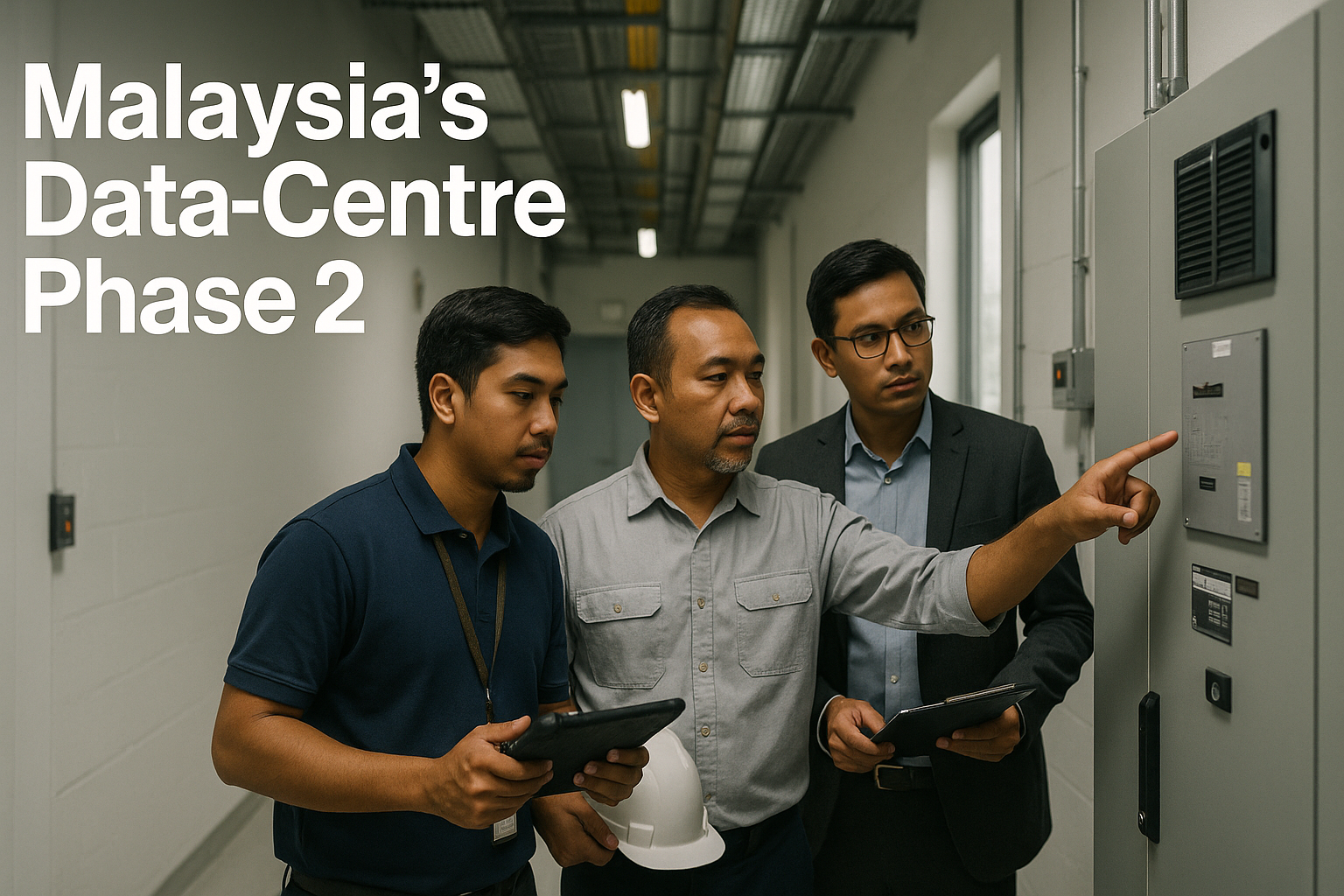
Malaysia’s data-centre ecosystem is moving into Phase 2: less attention on headline capex and more scrutiny on whether local suppliers can execute to operator standards—safely, reliably, and auditably. For Malaysian SMEs, the opportunity is real, but the bar is different from typical commercial projects. Global operators and their main contractors qualify vendors through pre-qualification, site access rules, QHSE, security controls, documentation discipline, and performance management that can remove a supplier quickly if outcomes slip. The implementation challenge is not “get an ISO certificate”—it’s building repeatable delivery systems and evidence packs that survive audits, incidents, and change orders. This guide gives a practical, supplier-focused roadmap to close capability gaps and become contract-ready for 2027 workstreams.
What actually changes in Phase 2—and why does it affect vendor selection?
Phase 1 of a boom is dominated by announcements, land, power, and anchor tenants. Phase 2 is dominated by execution: uptime, safety, incident prevention, and the supply chain’s ability to deliver under strict controls.
In practical terms, this shift matters because procurement teams stop asking only “Can you do it?” and start asking:
- Can you do it repeatedly, across multiple sites, under audit?
- Can you mobilise fast without increasing risk (safety/security/quality)?
- Can you document what you did, prove competence, and close out findings?
- Can you handle change control, warranty, and defects without disputes?
This is consistent with the direction Malaysian policymakers (including MIDA messaging) have been signalling: value capture depends on local supply chain performance—skills, standards, and delivery outcomes—rather than only headline investment.
Commercial consequence for SMEs: vendor status becomes an asset you must maintain. You are not just winning a job; you are entering a governance system (KPIs, audits, corrective actions, re-qualification, and potential removal). Your readiness must be operational, not cosmetic.
How do global operators and main contractors qualify vendors in practice?
Vendor qualification for data-centre work is usually a funnel. The exact documents differ by operator and main contractor, but the structure is common.
Step 1 — Pre-qualification (PQQ) and onboarding
You should expect requests for:
- Company profile, org chart, key personnel CVs and certifications
- Relevant project references and completion evidence
- Licences/permits relevant to your trade (as applicable)
- Insurance certificates (public liability, workmen-related coverage, professional indemnity where relevant)
- Financial stability indicators (latest audited financials if available, management accounts, bank references—depending on size and risk)
- QHSE policies and incident statistics (even if basic)
- Subcontractor approach (who you outsource to, how you control them)
Step 2 — Site access and workforce control
Before your team can enter a live site, expect:
- Mandatory inductions and competency checks
- Badging/access control procedures
- Rules on devices, photography, and information sharing
- Fit-for-work requirements and safety PPE standards
Step 3 — Work method approval
For many trades, you will be asked for:
- Method statements / safe work procedures
- Risk assessments (e.g., JSA/RA)
- Permit-to-Work (PTW) workflow readiness
- Lockout/Tagout (LOTO) discipline for energy isolation (where relevant)
Step 4 — Delivery, reporting, and performance management
Once working, you will be judged on:
- Incident reporting speed and quality (near misses included)
- Quality of records and handover documentation
- SLA compliance (response times, restore times)
- Preventive maintenance performance (if in facilities/M&E)
- Audit findings and closure rate
Removal risk is real: Many operators maintain approved vendor lists. Repeated safety breaches, documentation failures, or poor response performance can mean suspension or delisting—often without the negotiation leeway SMEs are used to in less critical industries.
What does “contract-ready” mean beyond signing a PO?
Data-centre contracts and work orders often contain commercial mechanics that punish operational ambiguity. Being contract-ready means you can execute without turning every change into a dispute.
Scope clarity and exclusions
Before mobilising, you need a scope pack that your operations team can run with:
- Clear deliverables, acceptance criteria, and handover items
- Explicit exclusions (what you are not providing)
- Interface assumptions (who provides shutdown windows, permits, escorts, lifting plans, etc.)
Common SME failure: sales agrees to “can do” statements; operations discovers critical exclusions too late; you end up absorbing cost to protect relationship.
Change control that works in the field
Expect frequent variations: access windows shift, sequencing changes, additional tests are requested.
Implement a simple rule:
- No work outside scope without a written variation / instruction reference
- A named person owns change logs (date, reason, cost/time impact, approval status)
- Weekly commercial-operational sync to prevent unbilled creep
Liquidated damages (LDs), warranty, and defects
You do not need to be a lawyer to manage these risks, but you do need to recognise them:
- LD exposure is often linked to schedule and downtime risk
- Warranty/defects obligations can extend beyond practical completion
- Back-to-back risk: your subcontractor’s failure becomes your liability
Operational implication: plan resourcing and QA checks to reduce rework, and ensure subcontractors sign terms that mirror your obligations.
Insurance expectations and proof
Operators and main contractors may require specific coverage levels and endorsements.
Practical approach for SMEs:
- Review insurance early—before tendering—so pricing reflects real cost
- Maintain an insurance evidence folder (current certificates, endorsements, renewal calendar)
- Align incident reporting with insurer notification requirements to avoid claim disputes
Paul Hype Page & Co. can help here in a practical way: reviewing contract mechanics for operational/financial consequences, setting up internal approval controls (so your team doesn’t accept unpriceable risk), and aligning documentation workflows with finance and audit readiness—without turning it into a legal memo.
Which operational capabilities do operators look for—and how do you prove them?
Operators do not only want “capable people”; they want evidence that capability is systematic.
QHSE as a daily operating system (not a binder)
You need three layers:
- Policy layer: safety, environment, quality commitments; roles and responsibilities
- Process layer: PTW readiness, risk assessments, toolbox talks, incident reporting, corrective actions
- Evidence layer: signed forms, training logs, competency records, audit results, corrective action closure
Minimum practical signals (even without formal certification yet):
- Named QHSE lead (can be part-time) with authority to stop work
- Basic incident/near-miss reporting with root-cause analysis (RCA)
- Document control (versioning, approvals, retention)
Reliability mindset for uptime-linked work
If your service can affect uptime (M&E, facilities, controls, ICT, security, logistics affecting spares), operators will look for:
- Preventive maintenance discipline (planned vs completed)
- Response readiness (on-call rota, escalation paths)
- Spares strategy (critical spares list, lead times, storage/handling)
- Mean time to respond/restore tracking (even if simple)
Auditability and traceability
Operators value suppliers who can answer quickly:
- Who did the work, when, with what tools, to what standard?
- What tests were run? Where are the results?
- Were instruments calibrated?
That means your workflows must generate records as a by-product, not as an afterthought.
Practical KPI examples SMEs can adopt:
- % planned work completed on time
- # of repeat defects within 30/90 days
- # of PTW rejections (leading indicator of documentation quality)
- Incident closure cycle time
- Training completion rate for site-critical modules
How should different SME categories prepare—what are the “qualification signals” for your trade?
Not all suppliers are judged the same way. Align your readiness investment to your risk profile.
M&E, facilities, and maintenance providers
You will be assessed on uptime culture.
Qualification signals:
- Competent persons for electrical/mechanical works (trade-appropriate)
- Planned maintenance system (CMMS preferred, but a controlled schedule can work initially)
- Call-out readiness: rota, response targets, escalation to senior tech
- Test/commissioning records and calibrated tools
- LOTO/PTW competence and supervision discipline
Construction, fit-out, and specialist trades
You will be assessed on interface management and safe execution.
Qualification signals:
- Method statements and sequencing plans that respect live-site constraints
- Permit discipline, lifting plans where relevant, supervision ratios
- Defect prevention: QA checklists, hold points, photographic evidence
- Subcontractor control and induction processes
Security services (guarding, access control, monitoring)
You are part of the trust boundary.
Qualification signals:
- Personnel vetting process (identity, background checks appropriate to role)
- Clear SOPs for access, visitor handling, incident escalation
- Shift handover logs, patrol/incident records
- Confidentiality obligations for staff (NDAs and conduct rules)
ICT, cybersecurity, and software vendors
You will be assessed on security governance and change control.
Qualification signals:
- Secure development / change management process (ticketing, approvals, rollback plans)
- Access management (least privilege, MFA where applicable)
- Vulnerability management and patching approach
- Incident response playbook and reporting timelines
- Evidence that you protect personal data under Malaysia’s PDPA where relevant (contextual compliance, not a legal deep dive)
Logistics, warehousing, and spares movement
You will be assessed on chain-of-custody and timing.
Qualification signals:
- Delivery appointment discipline and on-site rules compliance
- Chain-of-custody logs for critical items
- Packaging/handling SOPs (ESD/fragile handling where applicable)
- Ability to support urgent call-outs (nights/weekends)
Cleaning, waste management, and site services
You will be assessed on consistency, safety, and ESG evidence.
Qualification signals:
- Chemicals management and SDS control
- Waste segregation and disposal documentation
- Staff training, PPE compliance, and supervision
- Labour standards evidence (working hours, payroll compliance, contractor controls)
Niche services (calibration, pest control, rope access, fire systems, testing)
You will be assessed on competency and traceability.
Qualification signals:
- Calibration certificates and tool registers
- Technician competency records and refresher training
- Service reports with pass/fail criteria and corrective actions
Important: certifications like ISO 9001/14001/45001 or ISO 27001 can be powerful proof points, but they are most effective when they reflect real operating routines. Operators can usually tell when a system exists only to pass an audit.

What security and confidentiality controls are expected—even for “non-tech” vendors?
Data-centre environments treat many activities as security-relevant because physical access can create digital risk.
Physical security and access discipline
Even if you supply cleaning, catering, or minor maintenance, you may be asked to follow:
- Pre-approved staff lists (no last-minute substitutions without approval)
- ID badging and visitor escort rules
- Tool and material controls (what comes in/out)
- Restrictions on phones/cameras and information sharing
Personnel vetting and training
Operators commonly want suppliers to show:
- Identity verification and right-to-work checks (operationally important even when not formally requested)
- Role-based training: confidentiality, incident reporting, prohibited areas
- Disciplinary procedures for breaches
Chain-of-custody and secure disposal
For ICT, facilities, and logistics suppliers, chain-of-custody is often required for:
- Storage media, devices, sensitive components
- Keys, access cards, and security tokens
- Waste streams that could expose information (labels, documents, devices)
PDPA context (practical, not legalistic)
Malaysia’s PDPA is relevant whenever you handle personal data (staff records, visitor logs, CCTV access, customer details). Operators may not ask for “PDPA compliance” as a clause title, but they will expect:
- Controlled access to personal data
- Retention and secure disposal practices
- Breach escalation procedures
Where relevant, ISO 27001-aligned controls (or equivalent internal controls) can serve as credible evidence—especially for ICT/cyber suppliers. The goal is trust and auditability, not box-ticking.
How do ESG and labour standards show up in supplier onboarding—and what should SMEs do now?
By 2026–2027, many large buyers treat ESG as a supplier data requirement. For SMEs, the trap is treating ESG as branding rather than operations.
What you may be asked to provide
Common practical requests include:
- Basic emissions or energy data (often electricity, fuel, and fleet)
- Waste volumes and disposal method evidence
- Water usage (for certain services)
- Labour practices: payroll proof, working hours controls, no forced labour/child labour declarations
- Health and safety indicators (TRIR or incident stats—definitions vary)
Build “ESG data capture” into normal admin
You do not need a perfect sustainability report to start. You need controlled data.
Quick implementation steps:
- Assign an ESG data owner (often finance/admin) and an ops contributor
- Create a monthly ESG folder: utility bills, fuel receipts, waste consignment notes, training logs
- Standardise supplier declarations for your own subcontractors (labour and safety)
- Decide your boundary: what you can measure reliably vs what is estimate-only
Why finance and payroll discipline matters
If you cannot evidence payroll, overtime practices, or contractor payments, onboarding can stall.
This is an area where Paul Hype Page & Co. often fits naturally: helping SMEs build finance controls and payroll/workforce process discipline so ESG and labour-standard questions are answerable with documents, not explanations.
What should be inside a vendor evidence pack—and how do you keep it current?
A vendor evidence pack is your “audit survival kit.” Done well, it shortens onboarding cycles and reduces back-and-forth that burns management time.
Core sections of an evidence pack
Use a simple structure:
1. Company and governance
- SSM profile (where requested), org chart, key contacts
- Delegation of authority (who can sign what)
- Subcontractor policy
2. Financial and commercial
- Latest financial statements or management accounts (as appropriate)
- Bank reference or credit references (if requested)
- Insurance certificates + renewal calendar
3. QHSE system
- Policies (quality, safety, environment)
- Training matrix + training records
- Incident/near-miss log + RCA samples
- Internal inspection/audit checklist results
4. Operational capability
- SOPs/method statements templates
- PTW/LOTO competence evidence (training, permits where applicable)
- Equipment and tools register
- Calibration certificates and schedule
- Sample service reports and handover packs
5. Security and confidentiality
- Access control procedure for your staff
- NDA template / confidentiality policy
- Data handling procedure (especially for HR and visitor data)
6. ESG and labour
- Waste disposal documentation samples
- Utility/fuel data collection method
- Labour standards declaration and payroll process outline
7. References and performance
- Project list with client contacts (where permissible)
- KPI snapshots: response time, defect rate, completion rate
Keeping it current (the part most SMEs miss)
Treat the pack like a controlled system:
- One owner (not “everyone”) responsible for updates
- Version control and a quarterly review cycle
- A renewal tracker: insurance, licences, training expiry, calibration dates
- A “ready in 24 hours” rule: if a buyer asks, you can submit quickly
Operational benefit: you reduce tender friction and look like a low-risk supplier—often the deciding factor when price differences are small.
How do you build a quality-and-reliability operating rhythm that operators trust?
Operators trust suppliers who demonstrate a stable operating rhythm—planning, execution, review, improvement.
Put three meetings on the calendar (and keep them)
For contracts that matter, institutionalise:
- Weekly operations review (30–45 mins): planned vs completed work, risks, access constraints
- Monthly QHSE review (45–60 mins): incidents, near misses, corrective actions, training gaps
- Quarterly performance review: KPI trends, client feedback, improvement projects, re-qualification readiness
Make RCA and corrective action non-negotiable
When something goes wrong, operators want two things: containment and learning.
A lightweight RCA discipline:
- Immediate containment action (within hours)
- 5-Why or fishbone root cause (within days)
- Corrective action plan with owner and due date
- Verification check (did it work?)
Preventive maintenance and spares (for uptime-affecting suppliers)
If you support equipment, your plan should answer:
- What fails most often and what’s the early warning?
- What are the critical spares and where are they stored?
- What is your maximum response time and how do you staff it?
Even a simple critical spares list + reorder points can signal maturity.
Documentation discipline on site
Adopt “document as you go” rules:
- Service reports completed same day
- Photos captured to a controlled folder (if permitted)
- Test results attached before sign-off
- Supervisor checks before leaving site
This is where many SMEs win or lose trust. Great technicians without paperwork still fail operator audits.
What are realistic barriers and costs—and how should SMEs prioritise upgrades?
Readiness has real cost. The goal is to spend in the right order.
Typical cost buckets (plan, don’t guess)
- Training: safety modules, PTW/LOTO competence, technical certifications, supervisor coaching
- Systems: document control, ticketing, simple CMMS, asset/tool registers
- Assurance: internal audits, external audits for ISO (if pursued), gap assessments
- Insurance: higher coverage requirements and endorsements
- Tooling: calibrated instruments, testing equipment, PPE upgrades
- People: QHSE role (even part-time), site supervisor ratios, on-call allowances
A prioritisation rule for SMEs
Sequence your investment by risk-to-operator and speed-to-evidence:
- Immediate risk controls: safety, access discipline, incident reporting, supervision
- Evidence generation: document control, training records, tool calibration logs
- Reliability operations: response readiness, spares strategy, preventive plans
- External proof points: ISO certification and formal audits (when your system is stable)
Avoid the common spend trap
The trap is paying for certification before your workflows are ready. You end up with:
- Procedures no one follows
- Records created last-minute
- Audit stress and recurring nonconformities
If you do pursue ISO 9001/14001/45001 (common baselines depending on trade) or ISO 27001 (for security-relevant ICT services), treat certification as the final validation step—not the starting point.
Conclusion
Phase 2 of Malaysia’s data-centre boom rewards suppliers who can operate like long-term partners: safe, secure, reliable, and audit-ready. Becoming contract-ready is less about chasing logos on a website and more about building systems—QHSE routines, site access discipline, change control, documentation, incident learning, and measurable performance. Start by segmenting your services by risk (uptime, safety, security), build a vendor evidence pack that can be submitted within 24 hours, and implement a 30/60/90-day plan that prioritises risk controls and proof. Then invest over 6–12 months in deeper capability—systems, people, and credible assurance. If you want a structured implementation plan, Paul Hype Page & Co. can support the commercial and operational foundations—contract readiness, finance/process controls, workforce and payroll discipline, and ESG data readiness—so your team can qualify, onboard, and stay on the approved list.
FAQs
Expect a PQQ covering company profile, key personnel competency, relevant project references, licences/permits (where applicable), insurance, basic financials, QHSE policies and incident history, and how you control subcontractors.
It means you can execute repeatedly under audit: clear scope and exclusions, field-ready change control, documented QA/QHSE routines, incident learning (RCA and corrective actions), and records that support handover, warranty, and defect management.
Track planned vs completed work, response readiness (rota and escalation), preventive maintenance discipline, critical spares planning, repeat-defect rates, and time-to-respond/restore—supported by service reports and test/commissioning records.
Include governance (org chart, contacts, subcontractor policy), financial/insurance documents, QHSE policies and records, operational SOPs and sample reports, tools/calibration registers, security/confidentiality procedures, basic ESG and labour evidence, and project references/KPIs.
Even non-tech suppliers may face access controls, restrictions on devices and photography, approved staff lists, and tool/material tracking; if you handle visitor logs, CCTV access, or staff records, you should show controlled access, retention and secure disposal, and breach escalation procedures aligned to PDPA expectations.
Related Business Articles


Share This Story, Choose Your Platform!