
What’s in this article
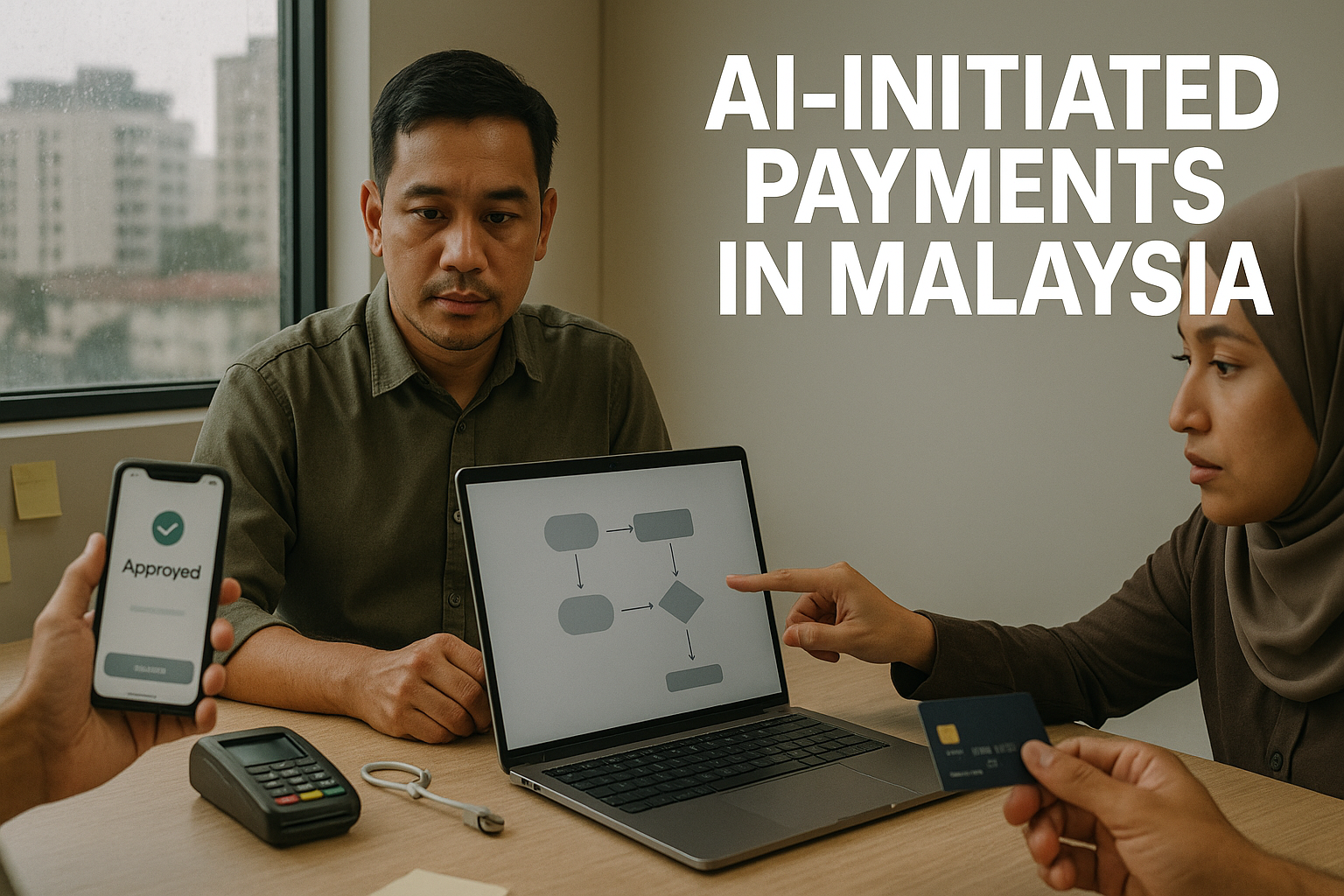
Malaysia AI payments are moving from concept to implementation planning: Mastercard’s stated rollout direction for AI‑initiated, authenticated payments in Malaysia is a near‑term signal that “agentic” transactions will shape checkout and billing design well before every customer uses them. For SMEs, the problem is not “do we believe in AI?”—it’s whether your current consent flows, payment gateway integration, fraud controls, and refunds/disputes operations can handle an agent acting on a customer’s behalf. Over the next 12–24 months, founders will need to redesign authorisation moments, update recurring and marketplace flows, and tighten reconciliation and dispute handling so that low‑friction “one‑click” does not become high‑loss “no‑control”. This guide gives a practical roadmap: what to build now, what to pilot, and what controls must exist before no‑click checkout arrives.
What should you treat as “agentic payments” in your operating model (without overcomplicating it)?
Agentic payments are best defined operationally, not philosophically: a payment instruction is initiated by software acting for a customer (or employee), within an authority the customer (or company) previously granted.
For implementation planning, treat three patterns as distinct because they drive different UX, controls, and liability outcomes:
1) Customer agent + consumer card/FPX wallet rails (B2C)
- The agent selects a product, triggers checkout, and confirms using a stored credential or token.
- You will still need step-up moments (for risky actions) and a clear record of consent.
2) Business agent + approval workflow (B2B)
- A system proposes a payment (supplier invoice, ad spend, logistics top-up), but humans approve based on limits.
- The key work is approval design, audit trails, and segregation of duties.
3) Marketplace agent + multi-party settlement
- The agent triggers a customer payment, then your platform must split and pay out to merchants/sellers.
- Your operational complexity is in reconciliation, refunds/chargebacks allocation, and payout reversals.
If you run subscriptions, marketplaces, or high-repeat purchases (food, tickets, essentials, digital services), you should assume agentic behaviour will show up first as:
- more stored credentials,
- more repeat orders,
- more “background” authentication events,
- higher dispute pressure if consent is unclear.
The roadmap below is built around those realities, not a speculative future state.
Where will your current payment flow break when the customer delegates authority to an AI agent?
Most Malaysian SMEs already support some combination of saved cards, recurring billing, or one-click checkout. Agentic payments stress-test three weak points that are usually “good enough” today.
Weak point A: Consent is implicit, but agentic transactions require explicit, provable mandates
In many checkouts, consent is implied by “Pay now” and a receipt email. With delegated agents, you need:
- an explicit permission model (what the agent can do),
- a record of the user’s consent and later changes,
- a way to show “why this payment was allowed” during a dispute.
Weak point B: Authentication is bolted-on, but agentic requires risk-based step-up
If every transaction triggers 3DS (or none do), you lose either conversion or control. Agentic flows work better when you can:
- allow low-risk repeats to run frictionless,
- step-up for new payees, new devices, higher amounts, address changes, unusual velocity.
Weak point C: Refunds and disputes are treated as customer support, but they become a core payments operation
When an agent buys on behalf of a user, you should expect:
- more “I didn’t authorise this” complaints even when the user delegated authority,
- more time-sensitive chargeback workflows,
- higher need for clean evidence (order logs, consent logs, delivery proof).
If you cannot produce an audit trail that ties together: consent → authentication decision → payment token → order → fulfilment → customer communications, you will struggle as volumes rise.
What decisions must you lock down before you touch gateway integration?
Before engineering starts, management should agree on a small set of commercial and operational decisions. These decisions reduce rework later.
Decision 1: What is your “delegated authority” policy?
Define what customers are allowed to let an agent do in your business:
- allowed categories (e.g., same merchant, same subscription, same basket type),
- amount limits (per transaction, per day/week),
- merchant restrictions (your brand only vs. partner ecosystem),
- whether the agent can add new shipping addresses or just use saved ones.
Practical output: a permission matrix that product, risk, and support can all reference.
Decision 2: What are your step-up triggers?
Pick the events that require user confirmation (in-app, OTP, 3DS challenge, biometric, or equivalent):
- first-time payment method,
- first-time device/session,
- new delivery address,
- new payee (B2B) or new seller (marketplace),
- high-value thresholds you set internally (avoid pretending there is a universal number),
- unusual velocity (multiple attempts, multiple cards, rapid repeats).
Practical output: a “step-up ruleset” that can be implemented in your risk engine and reviewed monthly.
Decision 3: What is your dispute posture?
Agentic payments increase disputes unless your customer communication is clear. Decide:
- your default refund window and exceptions,
- partial refunds vs. store credits policy,
- how you handle “agent error” (wrong item, wrong quantity),
- whether you will require additional confirmation for certain categories.
Practical output: updated refund policy and scripts that align with payments evidence needs.
Decision 4: Who owns payments operations end-to-end?
Many SMEs split responsibility across product (checkout), finance (recon), and support (refunds). Agentic flows require an owner. Set:
- a single accountable lead,
- a weekly metric pack (auth rate, chargeback rate, refund rate, manual review rate, recon breaks).
This is not bureaucracy; it is the minimum structure to avoid silent leakage.
What does a 12–24 month implementation roadmap look like for Malaysian SMEs?
Treat this as a staged build. You are preparing for 2027 by making 2026 a year of instrumented, controllable payment flows.
Phase 0 (Weeks 0–4): Baseline your payment reality
Goal: know what you’re dealing with before you redesign it.
Deliverables:
- Current flow maps (guest checkout, logged-in, saved card, recurring, refunds, chargebacks).
- Baseline metrics by channel:
- authorisation success rate,
- fraud rate (confirmed + suspected),
- chargeback/dispute rate,
- refund rate and reasons,
- reconciliation break rate and average time-to-close.
- A data inventory: what you log today (device, IP, order events, consent events) and what is missing.
Ownership:
- Product + engineering for flow mapping.
- Finance for reconciliation and settlement mapping.
- Support for refund/dispute mapping.
Phase 1 (Months 1–3): Fix the foundations (tokens, webhooks, idempotency, recon)
Goal: make your stack “agent-ready” even before agentic UX exists.
Minimum build list:
- Tokenisation readiness: ability to store payment credentials as tokens (not raw card data) where supported by your PSP.
- Network token support (where available via PSP): reduces card reissue churn and can improve success rates.
- 3DS options + step-up control: ensure you can support frictionless and challenge flows and can trigger step-up when your rules say so.
- Webhooks: reliable event handling for payment success/failure, disputes, refunds, payout events.
- Idempotency keys: prevent duplicate charges when agents retry or your system times out.
- Retries with backoff: controlled retry policies for soft declines (avoid infinite loops).
- Reconciliation pipeline: automate matching across orders, captures, refunds, disputes, settlements.
Control points:
- Daily reconciliation close SLA (e.g., “T+1 for 95% of transactions”).
- A “stop-ship if payment uncertain” rule for physical goods.
Phase 2 (Months 3–6): Redesign consent and authorisation UX (explicit vs delegated)
Goal: make customer authority legible, adjustable, and auditable.
Build:
- Consent ledger: a database record of what the customer agreed to, when, and via which channel.
- Permission controls: in account settings:
- allow agent purchases (on/off),
- spend limits,
- allowed categories/merchants (as your model requires),
- where the agent can ship.
- Step-up moments designed into UX: don’t hide them; explain them as “extra confirmation for your security.”
- Receipts that reflect delegation: show “initiated by your authorised assistant” (wording matters), plus a one-tap “report a problem” path.
Operational updates:
- Customer support macros tied to consent evidence.
- Internal playbook for “claimed unauthorised agent purchase”.
Phase 3 (Months 6–12): Implement agent-tuned fraud and abuse controls
Goal: assume automated behaviour will increase both legitimate and abusive attempts.
Add or tighten:
- Bot/agent detection: not to block agents broadly, but to identify automation patterns and route to the right controls.
- Velocity limits: per account, per device, per payment method, per IP/range, and per shipping address.
- Device/account signals: new device detection, risky location mismatch, email/phone change detection.
- Anomaly monitoring: alerts for spikes in refunds, disputes, declines, or retries.
- Kill-switches:
- global pause on agentic purchases,
- category pause (e.g., digital goods),
- seller pause (marketplace) triggered by abnormal behaviour.
- Human-in-the-loop fallbacks: manual review for:
- high amounts,
- new payees (B2B),
- first purchase after account takeover signals,
- new shipping addresses.
PDPA-aware practice (non-legalistic):
- Collect only what you need for fraud prevention and operations.
- Document internally why you collect device/network data and how long you keep it.
Phase 4 (Months 12–18): Expand into subscriptions, marketplaces, and B2B approvals
Goal: handle the hardest flows reliably.
Build patterns (details in later sections):
- Subscription mandate management (upgrades, proration, pauses, re-consent).
- Marketplace split settlement and refunds allocation.
- B2B approval workflows with limits and audit trails.
Phase 5 (Months 18–24): Pilot “no-click” experiences with guardrails
Goal: controlled rollout without uncontrolled losses.
Approach:
- Start with a narrow cohort (loyal customers, low-risk categories).
- Default to conservative limits and strong step-up triggers.
- Monitor weekly and adjust rules.
Exit criteria for scaling:
- Stable reconciliation close.
- Dispute rates within your acceptable band.
- Clear customer support outcomes (time-to-resolution, evidence retrieval time).
- Fraud loss rate within budget.
This sequencing is deliberately “boring”: the winners will be the SMEs that can run high automation with high controllability.
How do you redesign consent and mandates when authority shifts from “click to pay” to “delegate to pay”?
The core change is that consent becomes a product feature.
Build a two-layer consent model
- Base authority (standing permission): the customer authorises an agent to act within defined limits.
- Transaction authority (event approval): for higher-risk actions, you trigger step-up.
Examples of base authority settings:
- “Allow reorders of past baskets only”
- “Allow purchases up to RM X per day”
- “Allow subscription renewals and upgrades up to RM X”
- “Only ship to saved addresses”
Design step-up as a “moment”, not a failure
Customers should experience step-up as normal security hygiene. Good step-up UX includes:
- a clear reason (“New device detected” / “First purchase with this seller”),
- a single path to confirm (in-app approval preferred where possible),
- a fallback when users cannot complete (support-assisted verification).
Make consent auditable in a dispute
You want to answer, fast:
- What did the user authorise?
- When did they authorise it?
- Were limits exceeded?
- Did step-up occur? If not, why not?
- What was delivered/fulfilled?
Minimum logging fields (practical list):
- consent version + timestamp,
- account identifier,
- device/session identifier,
- risk score / rule outcomes (store the reason codes),
- payment token reference (not sensitive card data),
- order and fulfilment events.
This is where many SMEs benefit from an advisory partner such as Paul Hype Page & Co. to translate “policy language” into implementable controls and evidence requirements—so product, finance, and support are aligned before the first dispute wave hits.

What should you ask your PSP or gateway to confirm before you rely on agentic flows?
Your PSP/gateway is not just a payment button; it becomes the event source for automation, refunds, disputes, and reconciliation.
Use this readiness checklist when evaluating your current provider or planning upgrades.
Tokenisation and credential handling
- Do you support tokenisation for stored credentials?
- Do you support network tokens via card networks where available (through your PSP)?
- What happens when a card is reissued—do tokens update automatically or fail?
Authentication and step-up
- Do you support 3DS with both frictionless and challenge flows?
- Can you control when 3DS is invoked (risk-based triggering) vs. always-on?
- What data can you pass to improve risk decisions (device, customer tenure, shipping stability)?
Webhooks, event integrity, and idempotency
- Webhook coverage: payment authorised, captured, failed, refunded, disputed, reversed, payout initiated/failed.
- Delivery guarantees and retry logic for webhooks.
- Idempotency support for charge, refund, and payout APIs.
Disputes and refunds operations
- Can you pull disputes via API?
- Can you submit evidence programmatically or at least export structured data?
- Partial refunds support and refund status tracking.
Reconciliation and settlement
- Settlement reports availability and format.
- Payout schedules and fee transparency.
- Multi-currency handling (if you sell cross-border).
- Ability to link: transaction → fee → settlement batch → payout.
Failure modes you need to test
- Timeouts and retries (agentic systems retry more than humans).
- Duplicate requests.
- “Soft decline” loops.
- Webhook delays (what if fulfilment triggers before capture confirmation?).
A practical tip: run a “payments chaos test” in staging—simulate duplicates, delayed webhooks, partial refunds, disputes—and see if your finance team can still reconcile without spreadsheets and panic.
How should subscriptions and recurring billing change when customers use agents to manage renewals, upgrades, and cancellations?
Subscriptions are where agentic transactions become operationally visible first—because they are already “background payments.” The shift is that customers will delegate more lifecycle actions to software.
Redesign the subscription lifecycle around mandate events
Instead of treating subscription as “set and forget,” treat it as a set of mandate-relevant events:
- start subscription (initial consent + authentication),
- renewal (standing authority use),
- upgrade/downgrade (often requires step-up),
- price change (usually requires re-notification and sometimes re-consent, depending on your model and customer expectations),
- pause/resume,
- cancellation,
- failed payment recovery.
Practical flow changes
- Initial setup: strong authentication and clear display of renewal terms.
- Upgrades: step-up by default if price increases materially or if it’s a new plan category.
- Add-ons: treat as separate permission category (“allow add-ons without confirmation” is risky).
- Dunning (failed payment): agents may retry automatically. You must control retries to avoid:
- multiple authorisation attempts that look like fraud,
- customer frustration,
- higher dispute probability.
Operational requirements for finance and support
- A “single source of truth” for subscription status (don’t let billing and product disagree).
- Proration and refunds rules documented and consistently applied.
- Evidence pack for disputes:
- subscription terms shown,
- consent time,
- usage/benefit delivery (for digital services).
If you currently manage subscriptions manually (invoices + bank transfer reminders), consider whether agentic readiness is the trigger to standardise on a system that supports automated mandates, event logs, and clean reconciliation—without overbuilding features you won’t use.
How do marketplaces and multi-party payouts need to evolve for agentic transactions?
Marketplaces add two complexities: (1) the customer payment and (2) payouts to sellers/partners. Agentic payments increase volume and velocity, which amplifies small reconciliation and dispute weaknesses.
The key design choice: who is the merchant of record for the customer?
This is a commercial and operational decision with downstream implications for:
- refund handling,
- chargeback evidence,
- payout reversal mechanics,
- seller risk management.
Avoid treating it as “just paperwork.” Your payment flow, dispute process, and seller contracts must match the reality of who controls checkout.
Marketplace flow redesign checklist
At checkout:
- Item-level clarity (which seller, which fulfilment SLA).
- Rules for mixed baskets (multiple sellers) and partial fulfilment.
Post-payment:
- Split settlement logic with traceability:
- customer transaction ID
- seller payout ID(s)
- fees/commissions
- tax invoice linkage (where applicable in your process)
Refunds/chargebacks:
- Item-level refund capability.
- Allocation logic: platform-funded vs seller-funded refunds.
- Payout holds/reserves for high-risk sellers (commercially sensitive but often necessary).
Abuse controls specific to marketplaces:
- New seller velocity caps.
- Seller allowlists/denylists tied to behaviour.
- Pattern monitoring: high refund rates, delivery exceptions, unusual SKU swaps.
Agentic purchases will expose weak seller operations quickly. If your marketplace cannot reliably answer “who shipped what, when, and under what terms,” disputes will be expensive.
How should B2B payment approvals be designed if AI starts proposing supplier payments and spend actions?
For B2B, the most common near-term “agentic” behaviour is not a chatbot sending money; it’s systems proposing actions: pay this invoice, top up this account, renew this service, reorder this stock.
Build agentic capability as a controlled approval workflow
Start with “proposal + approval,” not “autopay everything.”
Minimum design elements:
- Spend categories: utilities, logistics, inventory, SaaS, marketing, professional fees.
- Approval limits: by role and by supplier (not just by amount).
- Segregation of duties: the person who creates/edits supplier bank details should not be the final approver.
- Change controls: step-up approvals for:
- new payees,
- changes to bank accounts,
- unusual amounts,
- expedited payments.
Evidence and auditability (practical, not over-legalised)
You want a clean chain:
- invoice received → matched → proposed → approved → paid → reconciled.
If you are using spreadsheets and email approvals today, agentic readiness is a strong reason to implement a lightweight procure-to-pay workflow—even if you keep the final payment initiation in your bank portal for now.
Common failure mode
Teams automate “payment initiation” before they standardise “master data” (supplier details, invoice references, cost centres). That creates:
- wrong-payee risk,
- reconciliation pain,
- month-end delays.
Sequence matters: standardise data and approvals first; automate initiation second.
What minimum fraud and abuse controls should exist before you offer one-click or no-click checkout?
Agentic behaviour increases both convenience and attack surface. Your goal is not to block automation; it is to make automation controllable.
Minimum control stack (SME-friendly)
1) Identity and account hygiene
- Email/phone verification and change confirmation.
- Alerts for key account changes (password, address, payment method).
2) Transaction controls
- Velocity limits (per account/device/payment method).
- Amount caps for delegated purchases.
- Category restrictions for higher-risk goods (e.g., instant digital delivery).
3) Signal collection (proportionate and PDPA-aware)
- Device/session identifiers.
- Basic network/location anomaly checks.
- Behavioural signals: rapid add-to-cart, repeated failures, scripted navigation.
4) Monitoring and response
- Real-time alerts for spikes.
- A manual review queue with clear SLA.
- Kill-switches with documented criteria.
5) Safe lists and deny lists
- Allowlist loyal customers for frictionless experiences.
- Denylist known abusive devices/accounts.
“Human in the loop” is not a downgrade—it’s a safety valve
For high-risk actions, design a deliberate handoff:
- the system pauses,
- the user confirms (step-up) or a staff member reviews,
- the action resumes.
This prevents small anomalies from becoming large losses.
What to measure monthly
- Fraud loss rate and top vectors.
- Chargeback/dispute rate by product category.
- % of transactions requiring step-up.
- Approval rate (authorisation success) and drop-offs.
- False positives (good customers blocked) and the cost of friction.
If you cannot measure these today, don’t ship no-click tomorrow.
Conclusion
Mastercard’s Malaysia rollout direction is a practical signal that agentic transactions Malaysia businesses will face are not a distant concept—they are a near-term product and operations challenge. The winners over 2026–2027 won’t be the SMEs with the flashiest AI story; they’ll be the ones with clear delegated-consent design, controllable step-up authentication, clean PSP/webhook/reconciliation plumbing, and disciplined refunds/chargebacks operations.
A workable next step is to run a 30-day baseline and gap assessment (flows, metrics, logging, recon breaks), then commit to a phased build: foundations first, consent UX second, fraud controls third, and only then broader subscription/marketplace/B2B automation. If you need help translating “policy” into implementable workflows—especially consent evidence, disputes operations, and finance reconciliation—Paul Hype Page & Co. can support planning and implementation so your team can scale low-friction payments without losing control.
FAQs
Expect more “unauthorised” claims and tighter evidence requirements, so you need an audit trail linking consent, authentication decisions, payment token, order and fulfilment events, and customer communications to resolve disputes quickly.
Use risk-based triggers such as first-time payment method, first-time device/session, new delivery address, new payee/seller, higher amounts, and unusual velocity—then review and tune the rules regularly.
Start with foundations: tokenisation support, webhooks, idempotency keys, controlled retries, and an automated reconciliation pipeline that can match orders, captures, refunds, disputes, and settlements.
Move from implied consent to explicit, provable mandates: a permission matrix (limits, categories, addresses), a consent ledger with timestamps and versions, and UX step-up moments for higher-risk actions.
Operationally, it’s any payment instruction triggered by software acting on a customer’s or employee’s behalf within authority that was granted earlier—most commonly reorders, subscription lifecycle actions, or B2B invoice payments proposed by a system and approved by people.
Related Business Articles

Share This Story, Choose Your Platform!